
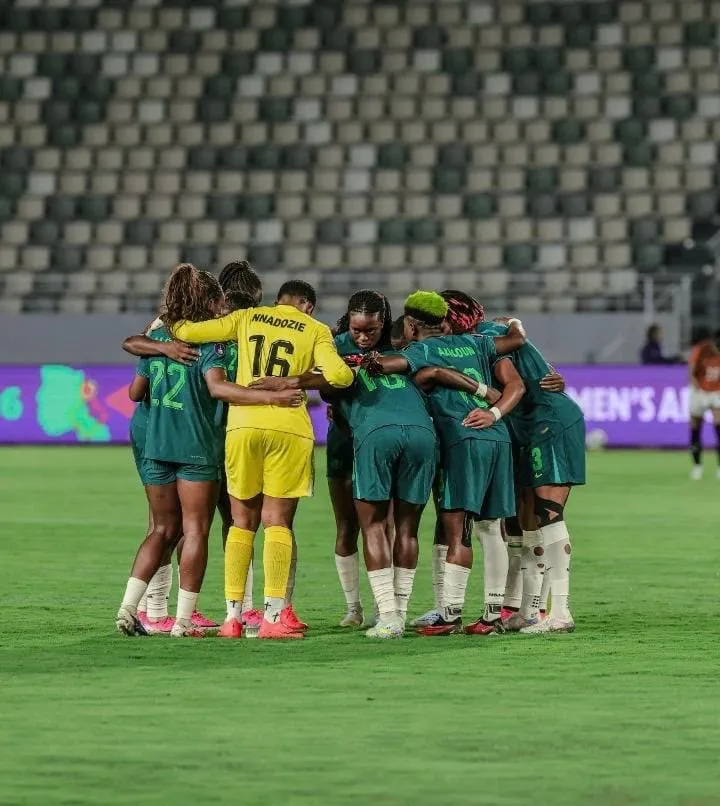
Super Falcons: What Next After World Cup Qualification Failure?

For the first time since the FIFA Women’s World Cup began in 1991, the Super Falcons will not represent Nigeria at the global tournament after their failure to secure qualification for the 2027 edition in Brazil.
Nigeria’s hopes of extending their ever-present record came to an end following a 1-0 quarter-final defeat to Cameroon at the Women’s Africa Cup of Nations, before a 2-1 loss to South Africa in the African play-offs finally ended their route to the World Cup.
The disappointment has triggered immediate changes within the national team, with the Nigeria Football Federation ordering head coach Justine Madugu and his entire technical crew to step down with immediate effect on Monday, August 17, 2026.
The decision marks the beginning of what could be a significant rebuilding process for the Super Falcons, as the NFF looks to establish a new technical structure following the team’s unprecedented failure to qualify for the World Cup.
Madugu era comes to an end
Madugu’s departure comes just over a year after he guided Nigeria to a record-extending 10th WAFCON title in 2025.
His success at the continental tournament earned him widespread praise and was viewed as another example of the potential of indigenous coaching within Nigerian football.
However, the failure to qualify for the World Cup has dramatically changed the situation.
Following the team’s disappointing campaign, Madugu accepted responsibility for the tactical shortcomings and apologised to Nigerians for the team’s performances.
His departure now leaves the NFF with the task of finding a technical team capable of restoring confidence and rebuilding a side that has traditionally been one of Africa’s dominant forces.
Pressure mounts on Nigerian football authorities
The Super Falcons’ failure has also intensified scrutiny on the wider administration of Nigerian football.
The Senate Committee on Sports has summoned National Sports Commission Chairman Shehu Dikko and NFF President Ibrahim Musa Gusau to demand explanations over what it described as the broader decline of Nigerian football.
The Super Eagles‘ own failure to qualify for the 2026 FIFA World Cup has added to the concerns surrounding the country’s national teams, placing greater pressure on the football authorities to provide answers.
The NFF has also initiated an investigative process to examine the circumstances surrounding the Super Falcons’ WAFCON campaign and identify the factors responsible for the team’s failure to secure World Cup qualification.
The outcome of that process could determine the next phase of the federation’s response and influence decisions regarding the structure and direction of the national team.
Olympic qualification offers a new beginning Super Falcons
With the World Cup dream now over, the Super Falcons must quickly shift their attention to another major international objective — qualification for the 2028 Los Angeles Olympic Games.
Nigeria’s Olympic qualification campaign is scheduled to resume in October 2026, with the second round set to begin on October 5.
The Super Falcons received a bye through the first round because of their strong continental ranking, giving them additional preparation time ahead of the next stage.
The African qualification process will be fiercely contested, with 35 nations competing through a series of knockout rounds. Unlike a conventional group-stage format, the campaign is built around two-legged home-and-away ties, leaving little room for mistakes.
Only two African teams will ultimately secure places at the women’s football tournament at the 2028 Olympic Games.
For Nigeria, the campaign represents an opportunity to begin rebuilding immediately rather than allowing the World Cup disappointment to define the next generation of the Super Falcons.
A chance to rebuild
The next few months will therefore be crucial for Nigerian women’s football.
The NFF must identify a new coaching structure, address the weaknesses exposed during the WAFCON campaign and ensure that the players are adequately prepared for the Olympic qualification battle.
Former Super Falcons captains and members of the current squad, including Esther Okoronkwo, have already stressed the importance of looking forward and focusing on the team’s next objectives.
For a team accustomed to appearing on football’s biggest stages, missing the World Cup represents an unprecedented setback.
But the Super Falcons now have another opportunity to respond.
The Olympic qualification campaign provides the first major test of whether Nigeria can turn the disappointment into a rebuilding exercise and begin the process of restoring the reputation of one of Africa’s most successful women’s football teams.