
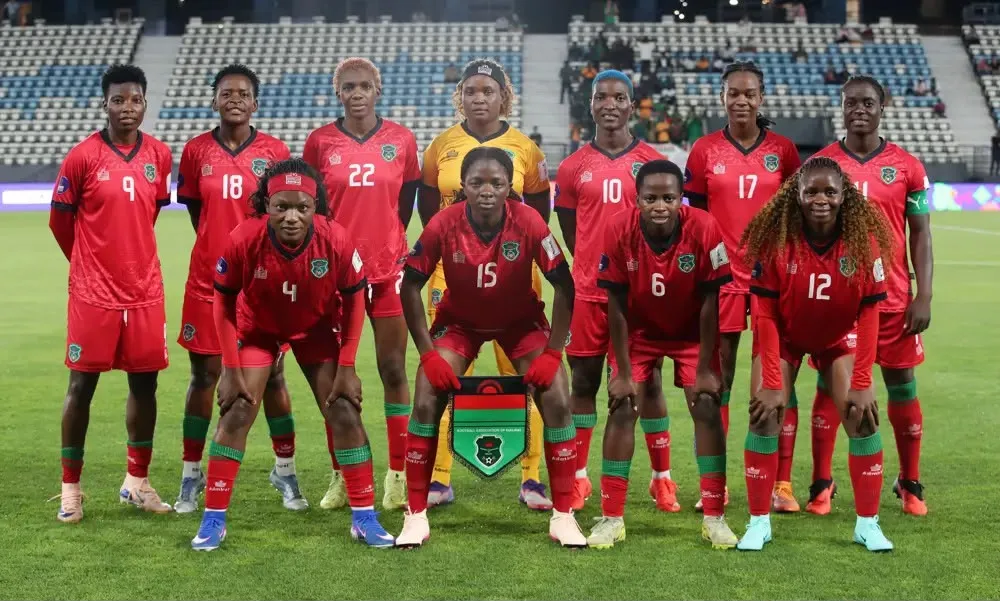
Malawi World Cup qualification signals new era for African women’s football

Malawi historic qualification for the 2027 FIFA Women’s World Cup has become one of the defining stories of the 2026 Women’s Africa Cup of Nations, with the Scorchers’ remarkable campaign challenging the traditional hierarchy of African women’s football.
Entering the tournament as debutants and ranked 153rd in the world, Malawi were drawn into Group C alongside Zambia, Egypt and 10-time African champions Nigeria. Few would have expected the Scorchers to emerge as one of the tournament’s biggest stories.
They announced their arrival in emphatic fashion in their opening match, defeating Nigeria 3-2 to immediately establish themselves as serious contenders.
The victory provided Malawi with the confidence to navigate the group stage successfully, as they finished top of Group C and advanced to the quarter-finals.
Their momentum continued in the knockout stages when the Scorchers defeated Ghana‘s Black Queens 2-1 in the quarter-finals. The victory secured their place in the semi-finals and, more importantly, guaranteed Malawi a historic place at the 2027 FIFA Women’s World Cup.
It was the first World Cup qualification in the history of Malawi’s senior women’s national team and the highest achievement yet for the country’s women’s football programme.
Malawi Challenging Africa’s established order
Malawi’s rise represents more than an individual success story.
For years, African women’s football has largely been dominated by established powers such as Nigeria, South Africa and Cameroon. Their consistency at continental competitions helped create a hierarchy in which emerging nations often struggled to challenge the traditional heavyweights.
That landscape, however, is changing.
The emergence of Ghana, Zambia, Morocco, Algeria and now Malawi has demonstrated the increasing competitiveness of the women’s game across the continent.
Malawi’s journey is particularly significant because the Scorchers did not simply participate in their first WAFCON. They competed against experienced opposition, defeated one of Africa’s most successful teams and progressed all the way to the final.
Although Cameroon eventually defeated Malawi in the final, the Scorchers had already achieved something historic by reaching the championship match and securing their World Cup ticket.
Chawinga sisters bring global attention
The Scorchers’ success has also provided greater visibility for Malawi’s players, particularly the Chawinga sisters.
Captain Tabitha Chawinga, who plays for Lyon Women in France, has become one of the most recognisable figures in Malawi’s team, while her sister Temwa Chawinga, a Kansas City player, has also established herself as a prominent name in the women’s game.
Their careers have provided young African players with visible examples of what can be achieved at the highest level.
The Chawinga sisters have also helped draw greater international attention to Malawi’s football story, giving the Scorchers faces and personalities that supporters around the world can connect with.
What the World Cup means for Malawi
Malawi’s qualification for the 2027 FIFA Women’s World Cup gives the country an opportunity to take its recent progress beyond the African stage.
The World Cup will expose the Scorchers to some of the leading women’s national teams in the world while providing their players with an opportunity to compete at the highest level of international football.
It could also create greater visibility for women’s football in Malawi and provide momentum for further investment in the development of the game.
For African women’s football more broadly, Malawi’s rise offers another indication that the gap between the continent’s traditional powers and emerging nations is becoming increasingly narrow.
The Scorchers entered WAFCON as newcomers.
They leave as finalists, World Cup qualifiers and one of the biggest success stories of the tournament.
Their journey has shown that African women’s football is no longer defined solely by its traditional giants. The next generation of challengers is already here and Malawi have shown just how far they can go.