

Exporting Dreams: The numbers behind Africa’s talent drain and gender divide

Footballers from Africa have always been in demand across the world. From Europe to Asia and the Americas, players from the continent have left home in search of bigger opportunities, stronger competition, and better wages.
For most of them, the dream is clear: to play at the highest level, in the biggest leagues, and under the brightest lights. But for every player who makes it to Europe’s elite clubs, thousands more leave the continent in search of opportunities, navigating a system where talent alone is never enough.
Over the last five years, this movement has only intensified. Some are well-established professionals, transferring for millions of dollars, while the majority are amateurs hoping to break into the professional scene in obscure leagues rather than wait for opportunities at home. Then there are the women footballers, a growing but still underrepresented group whose international moves signal progress and the long road ahead for gender equity in football.
The data behind this migration is sourced from FIFA’s Transfer Matching System (TMS), extracted through the Global Transfer Report on 28 February 2025. It includes all international transfers of football players completed between 1 January 2020 and 31 December 2024.
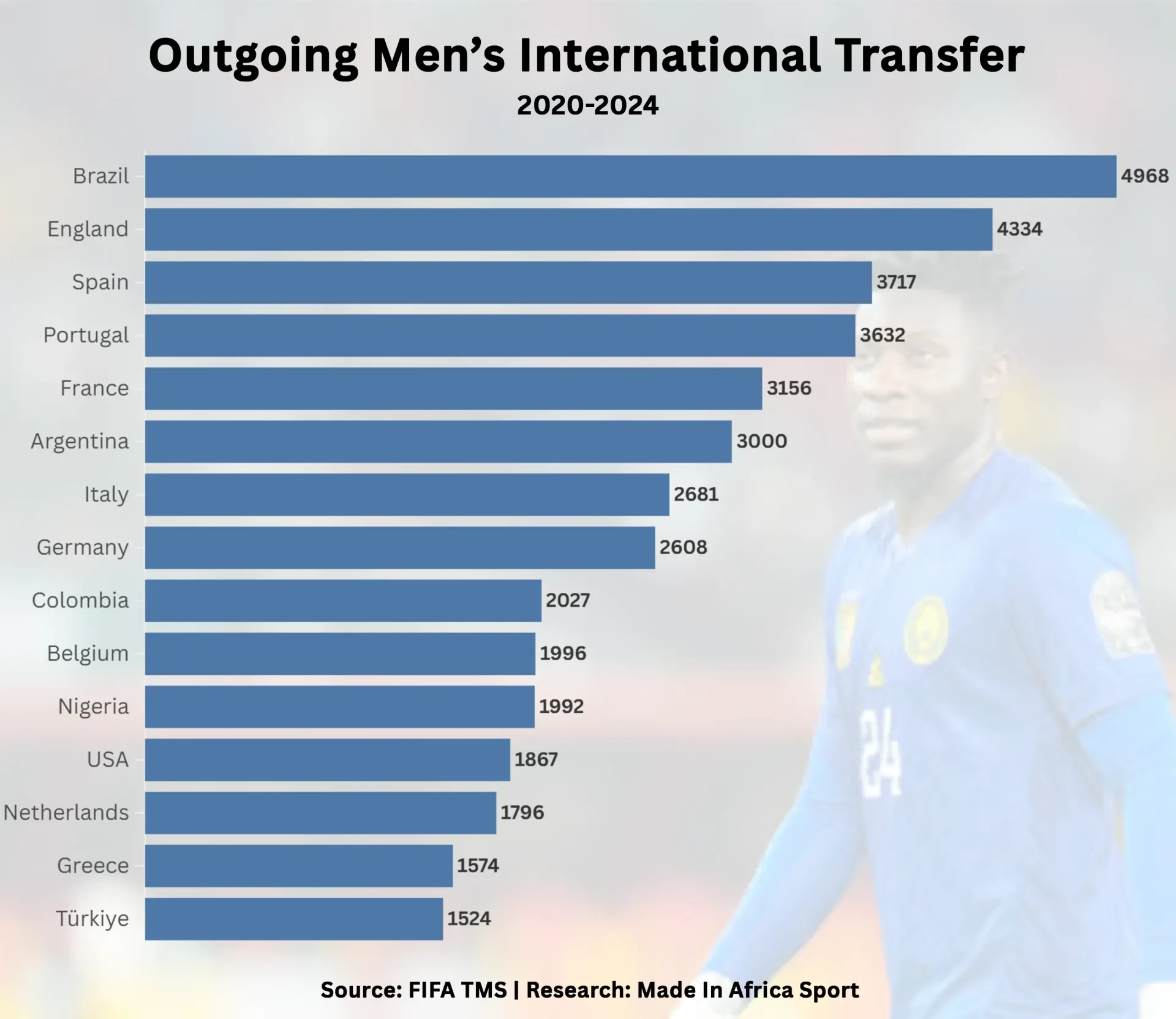
At the forefront of this talent exodus is Nigeria, the undisputed leader in football exports. With 3,915 outgoing transfers since 2020, the country has supplied more footballers to foreign leagues than any other African nation. Among them, 1,992 are professional male players, a number that places Nigeria just behind Belgium in the global rankings of football exporters.
But it is not only professionals who are leaving.
More than 1,700 amateur players have also made international moves, proving that the Nigerian football dream is pursued at all levels.
FIFA defines an amateur footballer as “a player who has never signed a professional contract and does not receive any remuneration beyond the reimbursement of expenses incurred during football-related activities.”
These players, unlike professionals, are not bound by club contracts and often rely on personal networks, trials, and lower-division leagues to establish their careers abroad. Their migration spotlights the risks faced by African footballers seeking opportunities beyond their home countries.
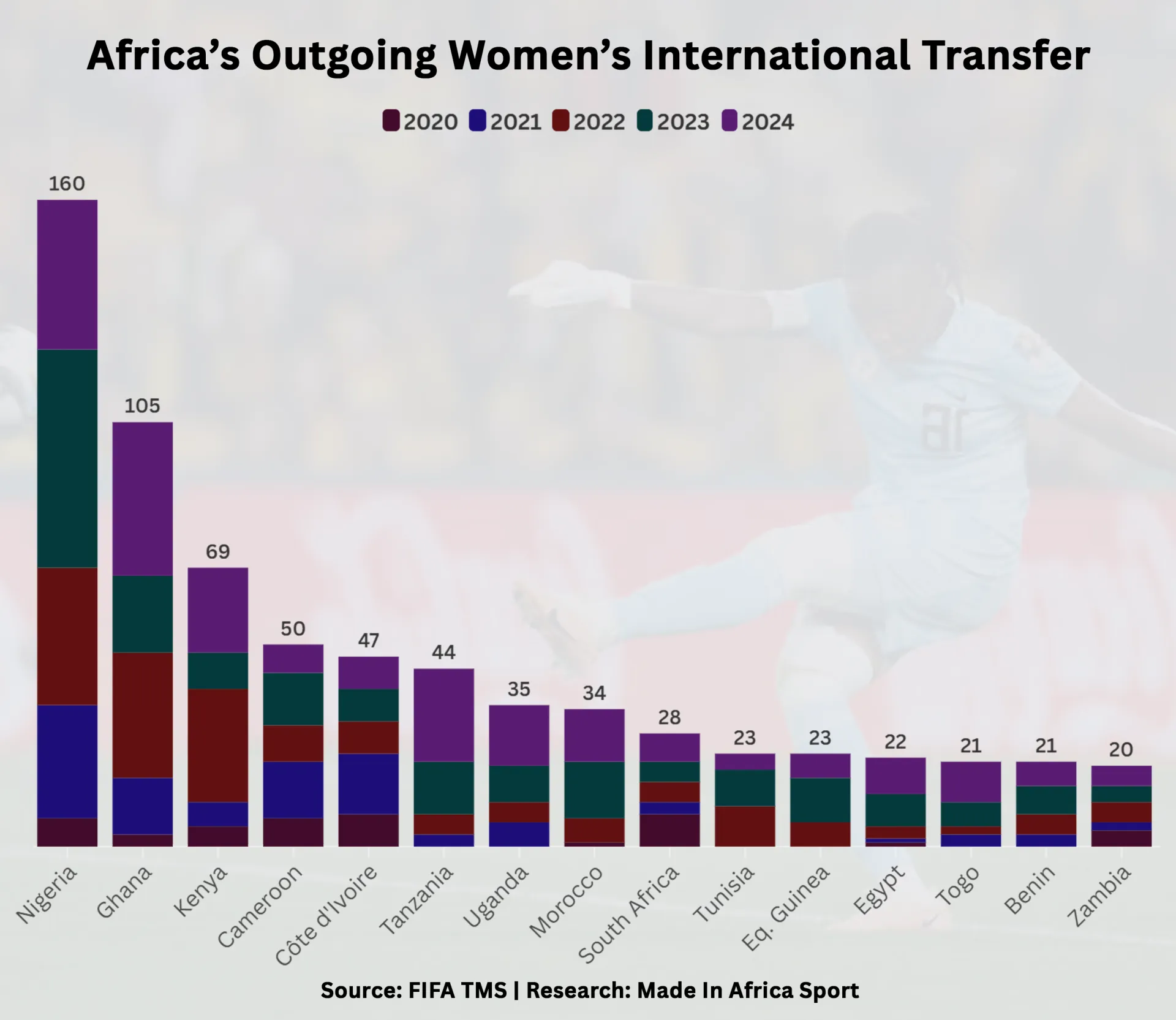
Nigeria is also leading the way in women’s football exports, with 160 female players moving to foreign leagues directly. This is more than any other African country, proving that Nigeria is the country where women’s footballer seeks greener pastures more than elsewhere on the continent.
Ghana follows closely, exporting 2,064 players since 2020. The country has long been known for producing highly technical and disciplined footballers, with scores of them finding success in leagues across Europe and beyond. Of these transfers, 1,190 were male professional players, while 769 amateur footballers left the country in search of better opportunities.
Women’s footballers are also leaving Ghana rapidly, with a continent-high 38 players transferring out internationally in 2024 for a total of 105 players over the last five years. This puts Ghana just behind Nigeria and ahead of all other 42 African nations to have sold at least a single player in that period.
Beyond West Africa, Morocco, Tunisia, and Egypt have also sent large numbers of players abroad, showing that North Africa is also a region for football exports.
Morocco has seen 1,588 players leave the country for foreign leagues, with 34 being professional women and 543 professional men, while the remaining 1,011 representing 64% of the country’s total export over the last half-decade are amateurs.
A further microscopic analysis depicts that while their numbers are not as high as those of Nigeria, Moroccan amateur departures are largely due to limited local opportunities or because of the strong scouting networks since they move to their fellow Arab leagues or developed southwestern Europe, unlike Nigerians with Czechia, Albania, Poland and Benin being their major destinations.
Tunisia and Egypt follow closely behind, with 1,475 and 1,343 outgoing transfers, respectively. Just like Morocco, their women’s football exports remain low, with Tunisia producing only 23 international transfers and Egypt 22.
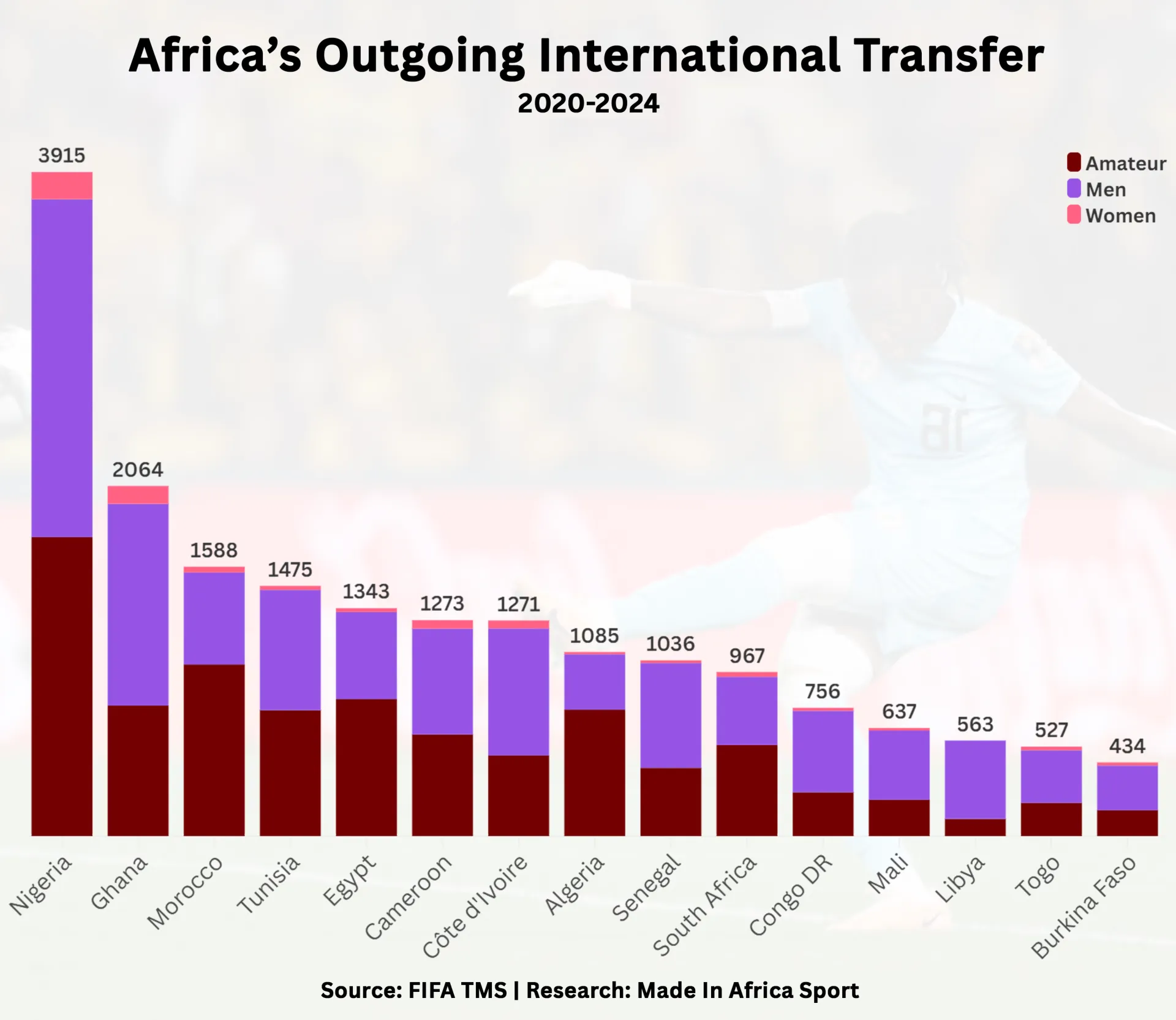
Cameroon and Côte d’Ivoire have continued their tradition of producing top footballing talent, each exporting over 1,200 players in the last five years. Côte d’Ivoire saw 749 professional male players leave the country, a figure that is higher than Cameroon’s 624. However, Cameroon has exported more female players, with 50 Cameroonian women securing transfers abroad compared to 47 from Côte d’Ivoire. Both countries also have a strong amateur football culture, with hundreds of young players choosing to take their chances outside Africa.
Algeria, Senegal, and South Africa complete the list of the top ten African nations producing the most exported players. Algeria has recorded 1,085 transfers, a number that is lower than that of its North African rivals but still places it among the biggest contributors to global football talent. Senegal, a country with a much smaller population compared to some of the other top nations, has exported 1,036 players, proving that football remains one of its strongest assets. Many Senegalese players have found success in French football, a trend that is likely to continue due to the historical ties between the two countries.
South Africa is in a unique position when it comes to football exports. The country has the best economy and one of the strongest domestic leagues on the continent, meaning fewer players seek moves abroad compared to other African nations. However, with 967 outgoing transfers over the last five years, South Africa remains an important producer of football talent. The country has also seen 28 female players make international moves directly over the last five years, a number that is lower when taking into consideration how big women’s football is in the country and how dominant their teams have been at both clubs and international levels.
Where do African players go? A look at the most common destinations
The data over the last five years also shows where African footballers are most likely to go, revealing patterns of the strongest football ties between Africa and the rest of the world.
Europe remains the most popular destination, with 10,160 players moving to clubs across UEFA-affiliated countries. This figure includes 6,220 amateur players, showing that many young African footballers are willing to take the chance of moving to European lower divisions and academies even before securing professional contracts.
Among professional players, 3,666 male footballers made the move, while 274 female players also transferred to European clubs. The numbers confirm Europe as the biggest importer of African talent, a trend that has existed for decades. With top leagues such as the English Premier League, La Liga, and Ligue 1 heavily scouting Africa, it is no surprise that a large number of players continue to move to Europe.
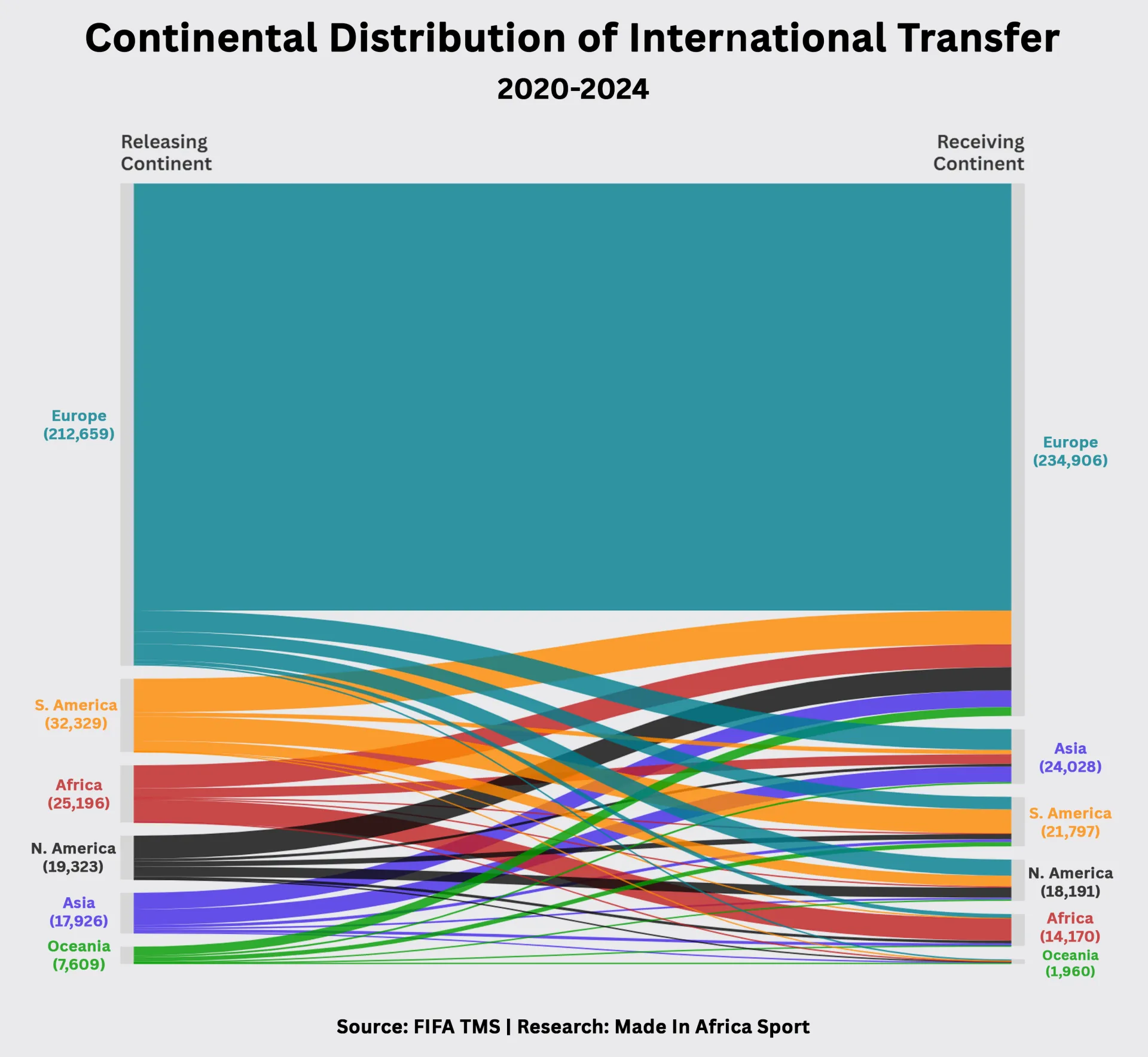
Within the African continent itself, there has been a high level of internal movement. A total of 9,870 local African players have transferred to other clubs within CAF-affiliated countries. This is the second-highest total after Europe and shows that many African players still prefer to stay within the continent rather than move far away.
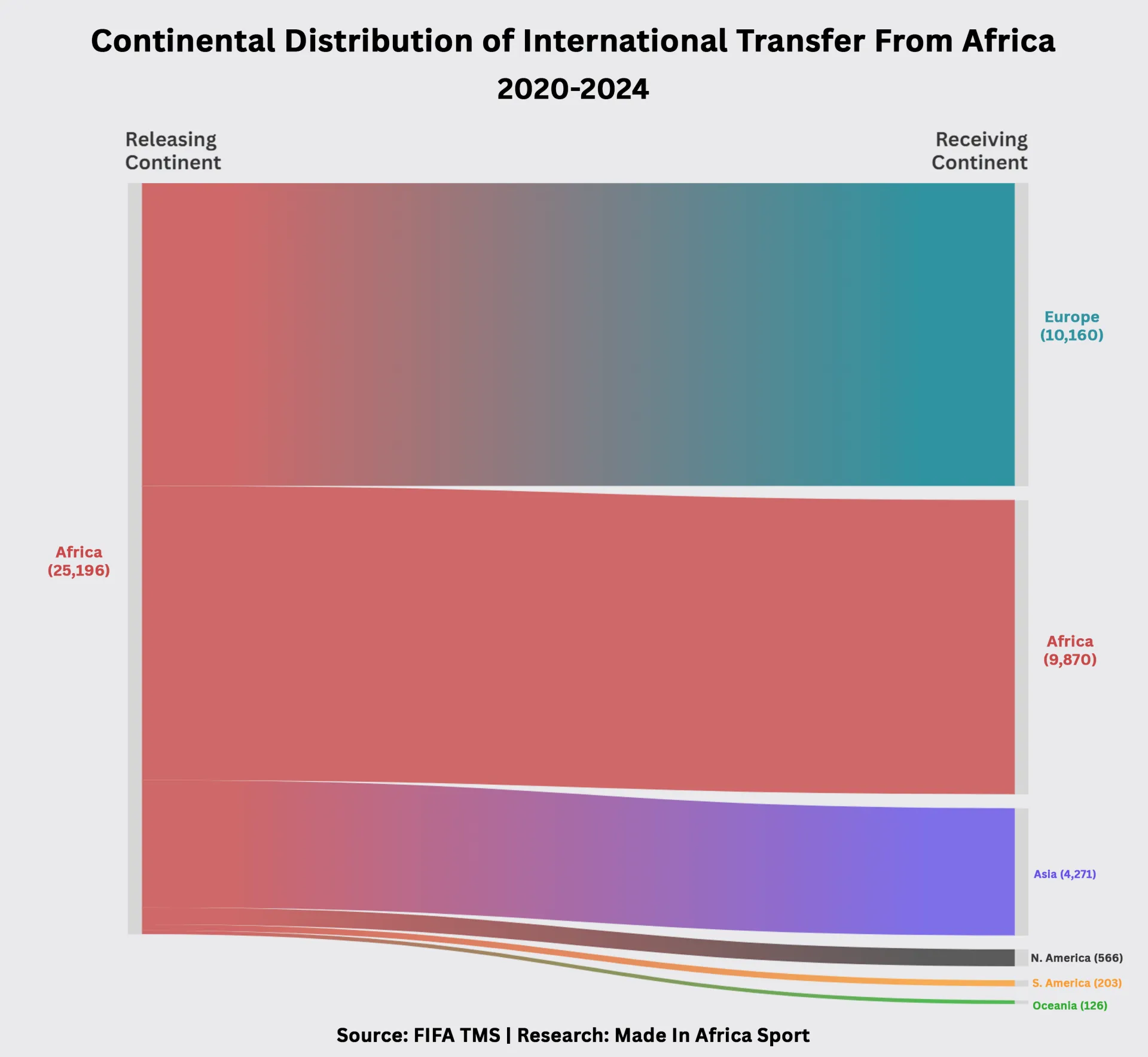
The majority of these transfers are professional moves, with 6,909 male players switching clubs within Africa. This suggests that despite the growing trend of international transfers, African domestic leagues still have strong recruitment networks that allow talent to move between different countries. The amateur game is also thriving within the continent, with 2,444 amateur players transferring to clubs in other African nations.
Women’s football has also been active in this internal market, with 517 female footballers moving between African leagues. While this number is lower than men’s transfers, it shows that women’s football in Africa is developing and that players are finding opportunities within the continent.
Asian football has also been attracting African players, with 4,271 transfers to AFC-affiliated clubs. A total of 2,333 professional male players have moved to Asia, a sign of the growing relationship between African footballers and leagues in countries such as Saudi Arabia, Qatar, the United Arab Emirates, and China.
Amateur footballers have also found opportunities in Asia, with 1,791 moving to clubs across the continent. Women’s transfers to Asia, however, remain low, with only 147 female players making the move. Despite this, the numbers indicate that Africa-to-Asia transfers are becoming more common, especially as wealthy Asian leagues continue to invest in foreign talent.
North and Central American leagues under CONCACAF have not been as popular as European or Asian leagues, but they have still attracted 566 African players over the last five years. Most of these transfers have been amateur moves, with 458 players making their way to clubs in North and Central America or the Caribbean. Professional men’s transfers have been much lower, with only 107 male players moving to CONCACAF-affiliated leagues. Women’s football in the region has received very few African players, with just one transfer recorded over the five years.
South American football has traditionally not been a major destination for African players, and the data confirms this. Only 203 African footballers have moved to CONMEBOL-affiliated clubs in the last five years. This includes 144 professional male players and 57 amateurs. Women’s football transfers to South America have been almost non-existent, with just two female African footballers moving to clubs in the region.
The Oceania region has seen the least number of transfers, with only 126 African footballers moving from the continent to OFC-affiliated clubs. All of these have been amateur transfers, with the entire 126 players moving to teams in countries like New Zealand and the Pacific Islands. There have been no recorded professional men’s or women’s transfers to Oceania in the last five years, making it the least common destination for African footballers. Vice versa, there was no recorded professional player transfer from Oceania to Africa either, showing that there are zero historical ties between Africa and Oceania.
The African nations bringing in the most foreign footballers
While it is good that African players are being recognised and recruited by foreign leagues, there is also the issue of how to strengthen African domestic competitions so that fewer players feel the need to leave. Even though the real question is whether they can retain their top talents rather than just serving as a stepping stone to Europe and Asia, the level of internal transfers within Africa itself and also small-scale importations from abroad suggests that the continent’s leagues are growing.
Football is a sport of movement, not just on the pitch, but also across borders. While much is said about African players leaving the continent for foreign leagues, there is also a growing trend of players moving into Africa.
Over the last five years, some African countries have increased their intake of foreign players, attracting talent from around the world. Whether for financial reasons, league development, or strategic recruitment, these countries are now becoming major importers of footballers, shifting the narrative of African football as purely an exporter of talent.
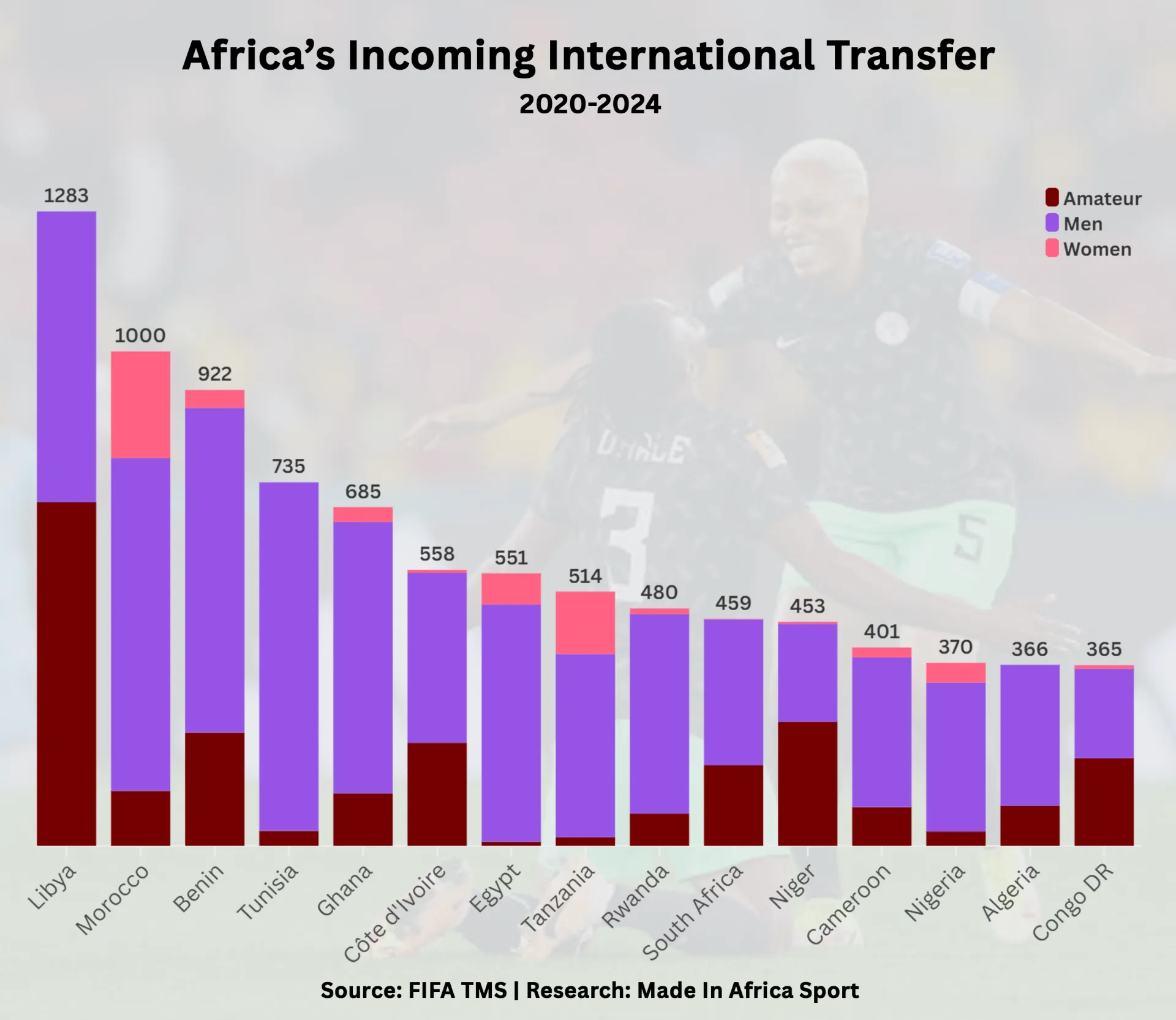
Libya took the top spot as the biggest importer of footballers in Africa, with a total of 1,283 international transfers recorded. While the country has faced challenges on all fronts in recent years, football remains an important part of its identity. The majority of these transfers have been amateur players, with 695 moving into Libya, while 588 professional male footballers have also joined Libyan clubs. Women’s football, however, has yet to see any international transfers, palpably due to the absence of a women’s league in the country.
Morocco has also been a major destination for foreign players, bringing in 1,000 international transfers. Unlike Libya, Morocco’s recruitment has been more balanced, with a strong presence in women’s football as well. Out of the total imports, 673 were professional male players, while 216 female footballers also joined Moroccan clubs. This makes Morocco the topmost African country actively attracting foreign women’s talent, showing their commitment to the growth of women’s football. Amateur transfers have been fewer, with only 111 players moving in at that level.
Benin is another country that has seen a surge in foreign player recruitment, bringing in 922 transfers, of which 299 are amateurs. The country has mostly targeted professional male players, with 657 moving to Beninese clubs. Women’s football, which has not seen much growth, had 36 female players arriving from abroad.
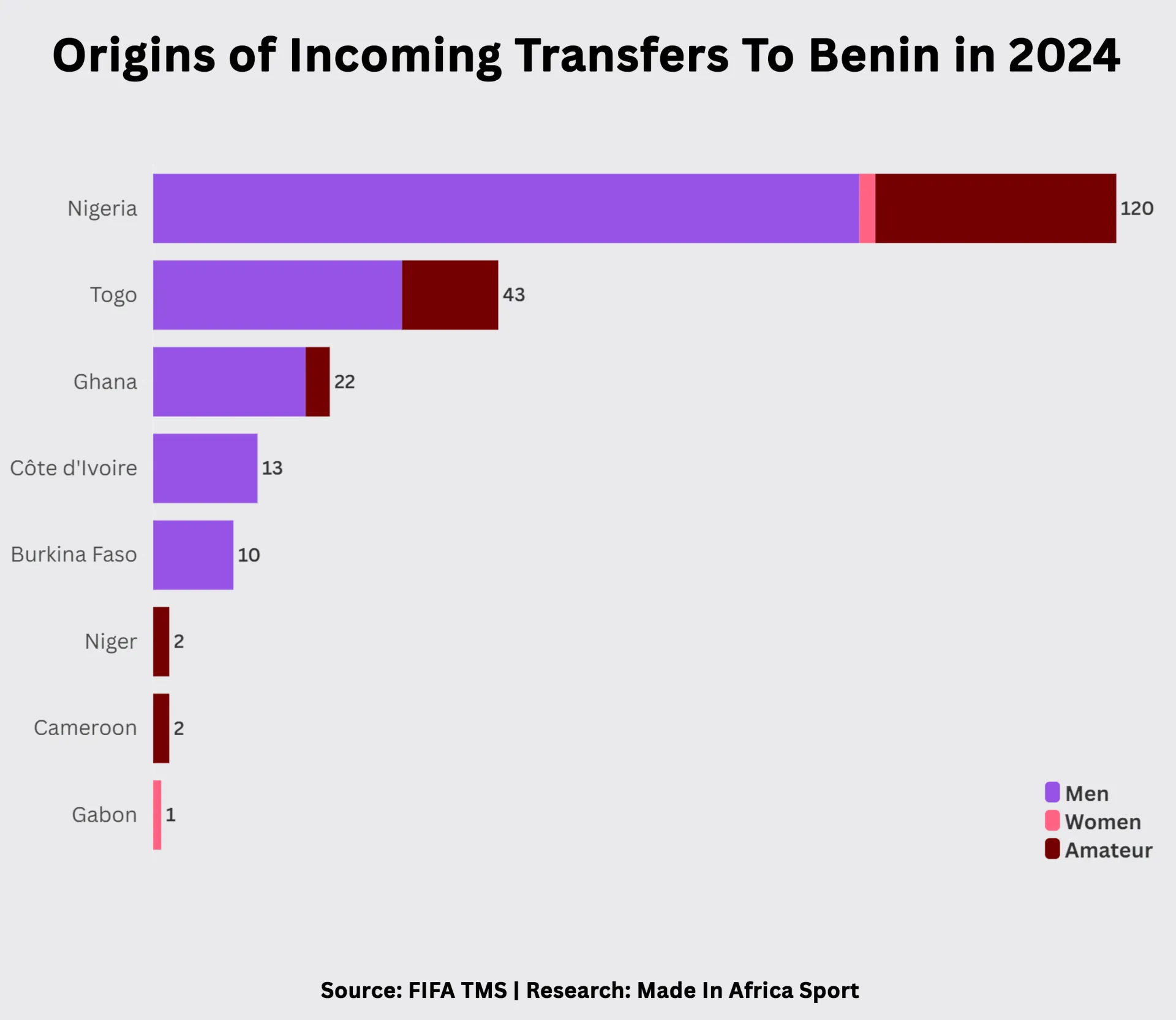
Interestingly, Benin has been raiding their bordering neighbour, Nigeria, to poach players. Of all the 242 international transfers the country had in 2024, 120 were Nigerians, representing 50% of their entire imports.
Fourth in most international signings is Tunisia, a country that has long been one of Africa’s most competitive football nations, and it continues to attract foreign talent, predominantly in men’s professional football. A total of 735 international players arrived in the country, with 705 of them being professional male players.
This heavy focus on the men’s game shows that Tunisia remains a key market for players looking to break into Africa’s top leagues. Like Libya, Tunisia has seen no recorded international transfers in women’s football despite the presence of the Tunisian Women’s Championship that has been running for 20 years, indicating that recruitment strategies have been more focused on maintaining the strength of the men’s league only.
Ghana, which has always been known for exporting talent, is also bringing in foreign players, with 685 international transfers recorded. Most of these have been professional male players, with 549 joining Ghanaian clubs. Women’s football is also seeing some movement, with 30 female players arriving in Ghana over the last five years. Amateur transfers have been more limited, with 106 players joining at that level. The numbers suggest that while Ghanaian football remains largely focused on developing homegrown talent, there is also a growing interest in foreign recruitment to boost domestic competition, at least in men’s football.
Côte d’Ivoire has been another active recruiter of foreign players, with 558 international transfers recorded. The country has seen a balanced mix of amateur and professional imports, with 208 amateur transfers and 344 professional male transfers. Women’s football, however, has had fewer international arrivals, with just six female players recorded.
Egypt, one of Africa’s footballing giants, has also been welcoming foreign players, with 551 transfers recorded. A total of 480 professional male players have joined Egyptian clubs, while 63 female players have also been recruited. However, amateur transfers have been almost nonexistent, with only eight recorded over the last five years, a trend that suggests Egypt’s clubs are mainly targeting experienced players rather than bringing in young talents to develop over time.
Tanzania has emerged as a rising force in African football, attracting 514 international transfers. The country’s recruitment strategy has been more balanced, with 371 professional male players joining Tanzanian clubs. Women’s football has also been an area of focus, with 126 international female transfers recorded, making Tanzania one of the top African nations in this category. However, amateur transfers have been low, with only 17 recorded.
Rwanda has also been increasing its intake of foreign footballers, with 480 international transfers. The majority have been professional male players, with 404 joining Rwandan clubs. Amateur transfers have been relatively low at 65, while women’s football has seen only 11 international arrivals.
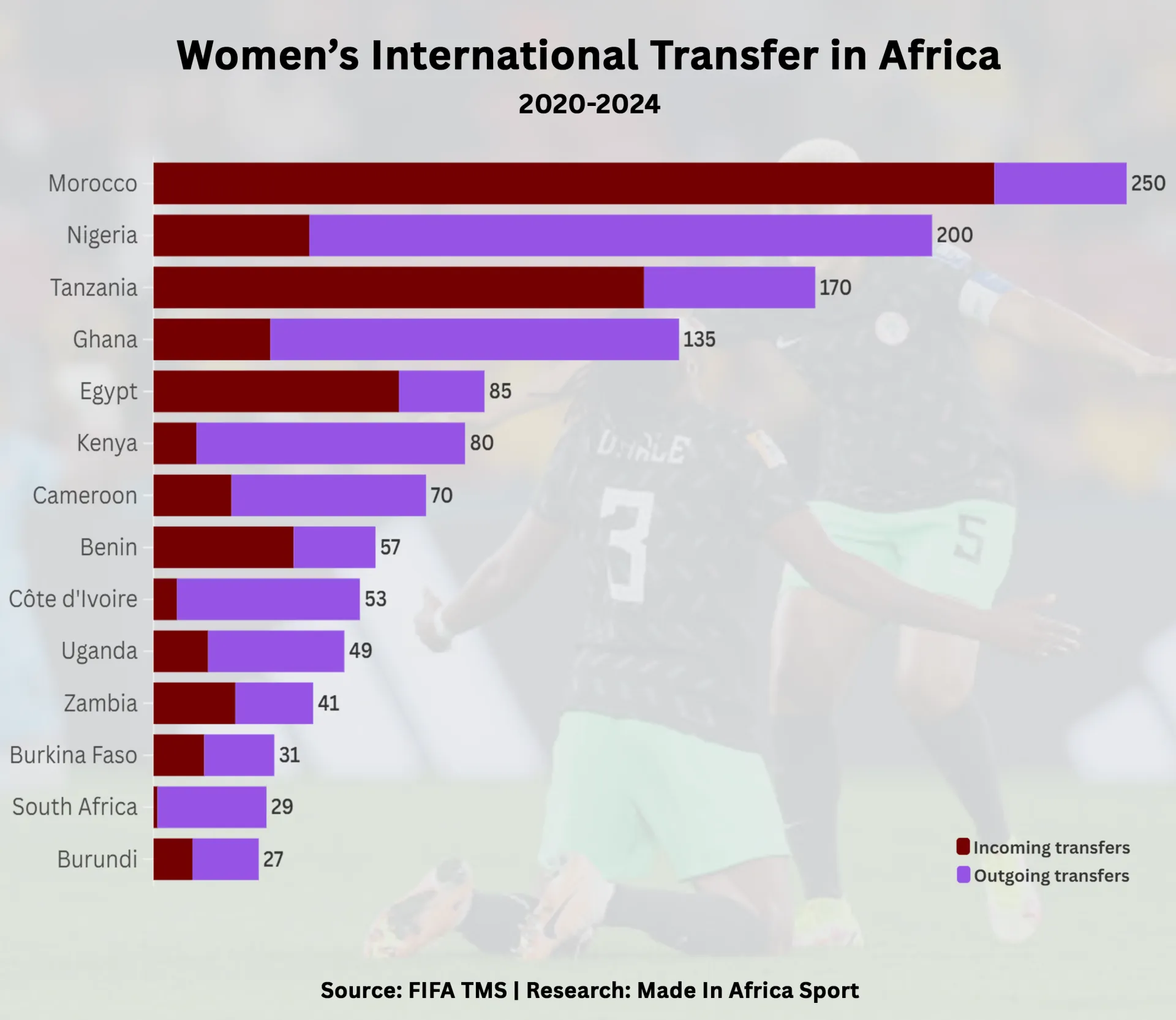
South Africa completes the top 10 having brought in 459 foreign players over the last five years. Most of these have been professional male players, with 295 transfers recorded. Amateur football has also been active, with 163 players moving to South African clubs. However, they have one recorded foreign incoming women’s transfer, meaning the country is nearly absent from the international women’s transfers scene with a total of 29 net transfers in five years, placing them 13th on the list of countries with the most involvement in women’s transfer on the continent despite their strong domestic league structure.
Investment in women’s football: Are their transfers becoming more financially competitive in Africa?
Women’s football transfers have seen unprecedented growth worldwide, but in Africa, the financial competitiveness of the market remains far behind. While global spending on female transfers reached record levels in 2024, African nations barely made a dent in the numbers.
Clubs worldwide spent 15.6 million dollars on women’s international transfers in 2024, more than double the 6.1 million dollars recorded in 2023.
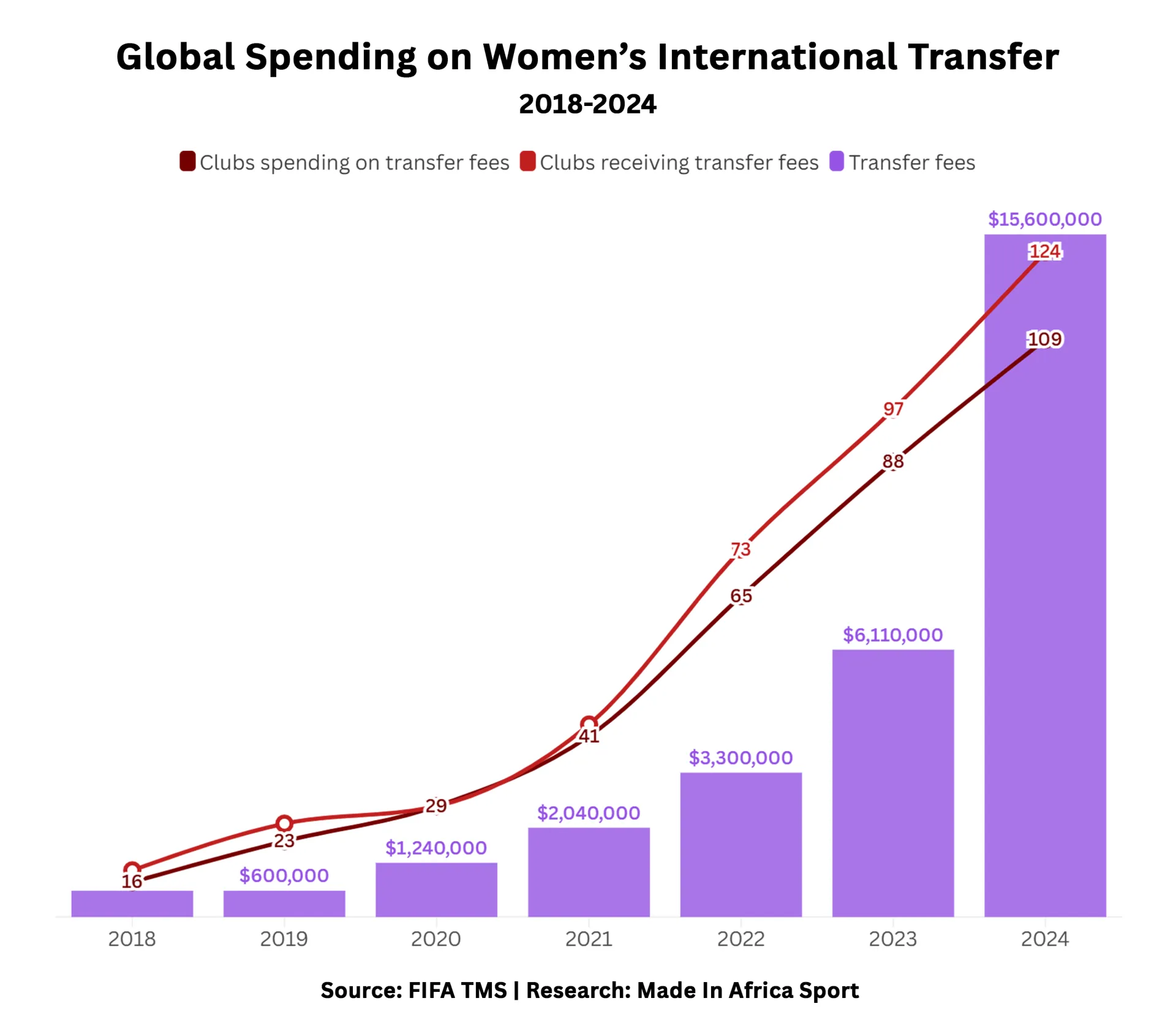
The number of clubs involved in deals with transfer fees also reached an all-time high, with 109 clubs spending money and 124 clubs receiving fees. Leading the way were clubs from England, Spain, and the United States, where player sales brought in millions of dollars. No African nation came close to those figures.
Ghanian clubs led the continent in outgoing transfers, with 38 players moving abroad in 2024, placing the country 20th worldwide. Nigeria followed closely in 21st place with 37 players. Yet, these transfers barely translated into substantial financial returns as the entire continent received just 61,700 dollars in total transfer fees for female players.
From this, Ghana accounted for 16,200 dollars, while Nigeria earned 6,005 dollars, and the remaining 34 African nations involved in transfers shared 39,495 dollars from the 197 players they exported.
While this marked a 23.5% increase from 2023, it was still lower than in 2022, when 131,000 dollars was earned from player sales.
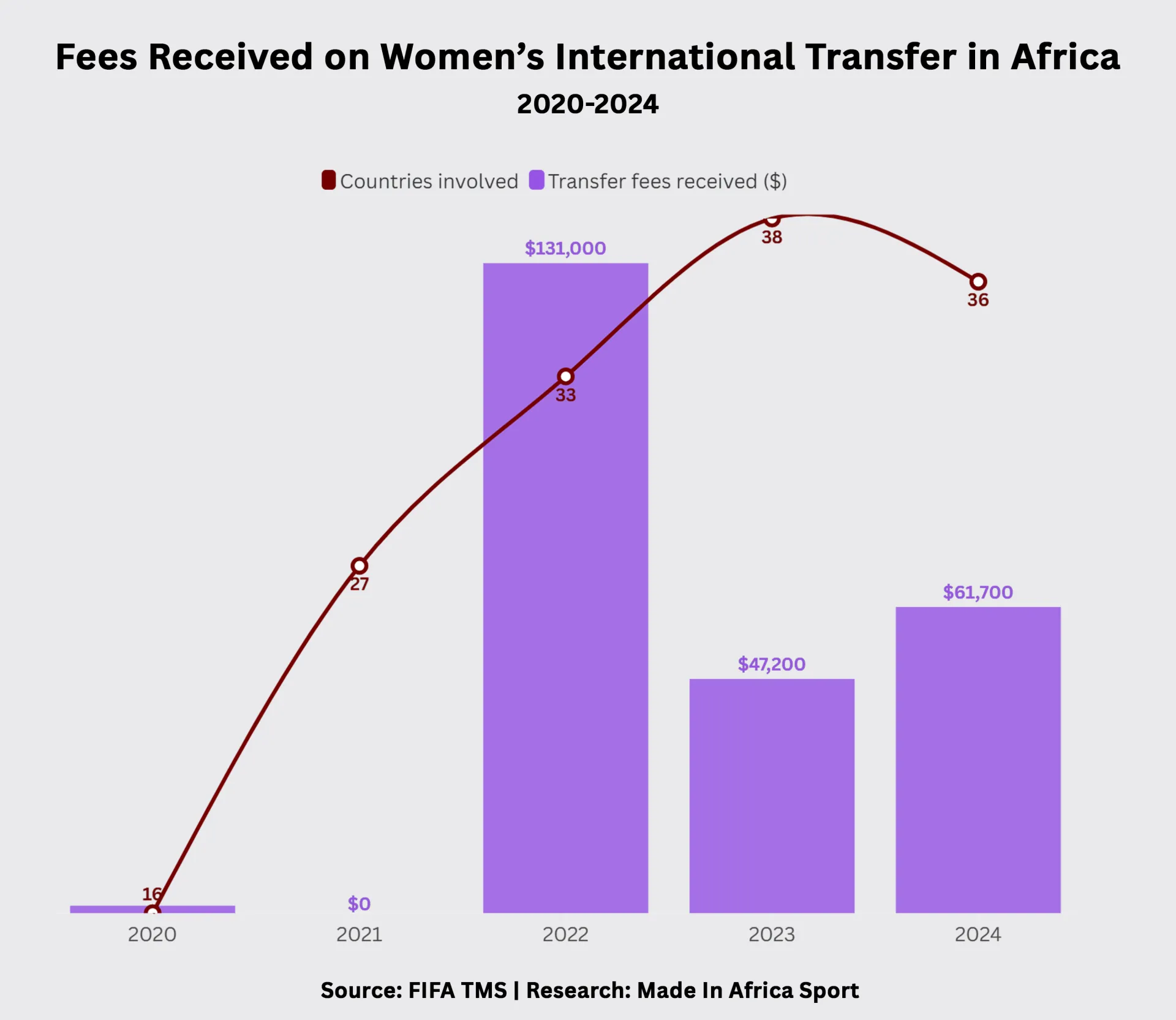
The inconsistency in revenue from these transfers suggests that African clubs are not yet in a position to negotiate higher fees for their players, despite increased participation in the global market, and the pattern is even more concerning when looking at the money spent on signing foreign players.
In 2024, 16 African countries signed female players from abroad, yet the total amount spent was just 3,310 dollars. This was almost three times lower than the record 8,120 dollars spent in 2022, indicating a continued reluctance to invest in recruiting talent.
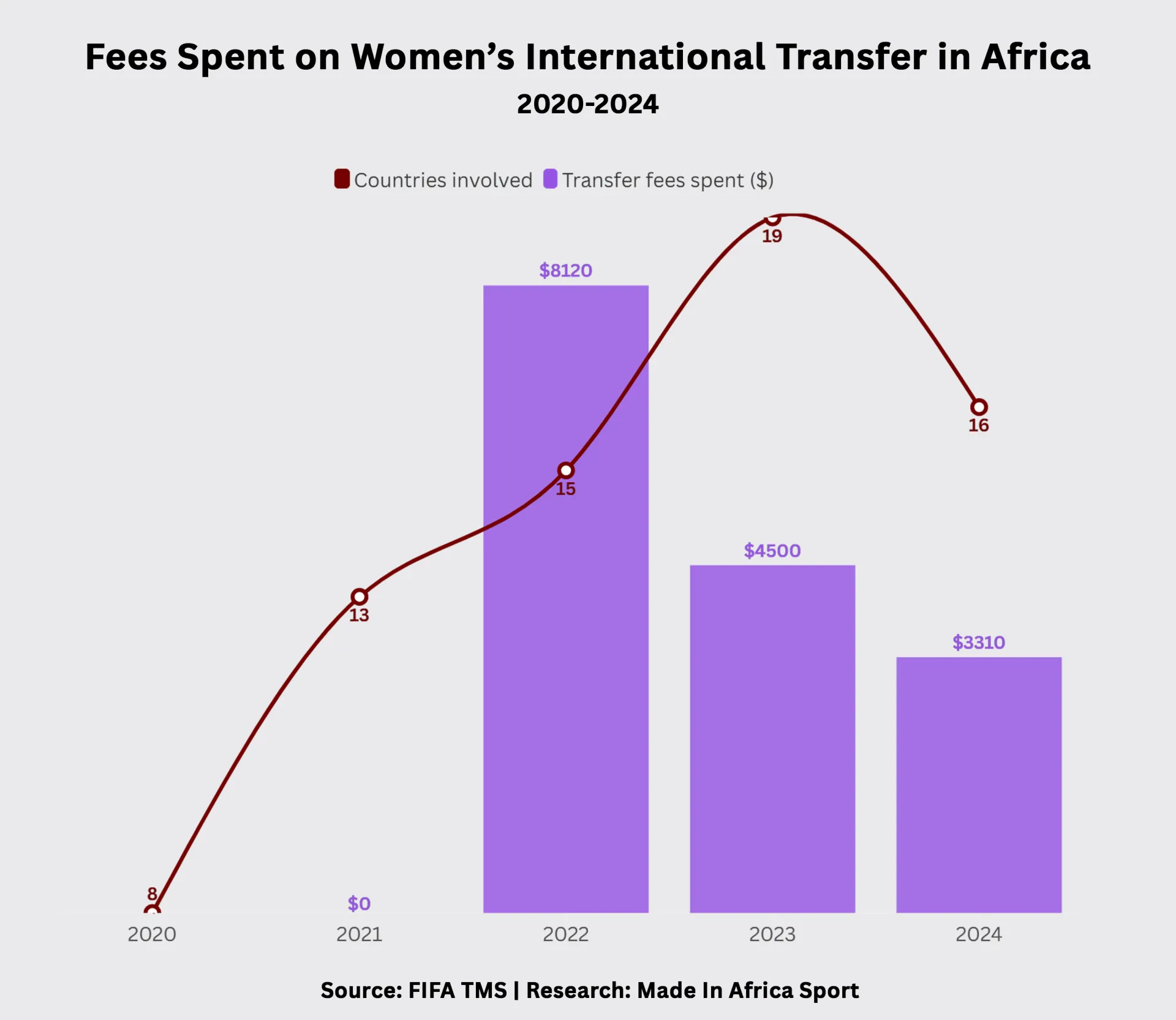
These fluctuations in spending and earnings reflect an unstable transfer market for African women’s football. The sharp rise in transfer revenue in 2022, followed by a steep decline in 2023, suggests that African clubs are not consistently benefiting from the international market. Likewise, the decrease in spending on foreign players shows that investment in squad improvement is not a priority for most African teams.
However, one country has been pushing against this trend. While the rest of Africa struggles with low investment in women’s transfers, Morocco has been making moves to strengthen its league.
The North African country accounted for 33% of all international women’s transfers into Africa in 2024, signing 73 players. It was a record-breaking figure for Morocco and a clear statement of intent.
Their commitment to women’s football has been evident over the last five years. In 2020, Morocco brought in just 12 foreign players. By 2021, that number had skyrocketed to 54. There was a dip to 35 in 2022 before the numbers began to rise again, reaching 42 in 2023 and an all-time high of 73 in 2024.
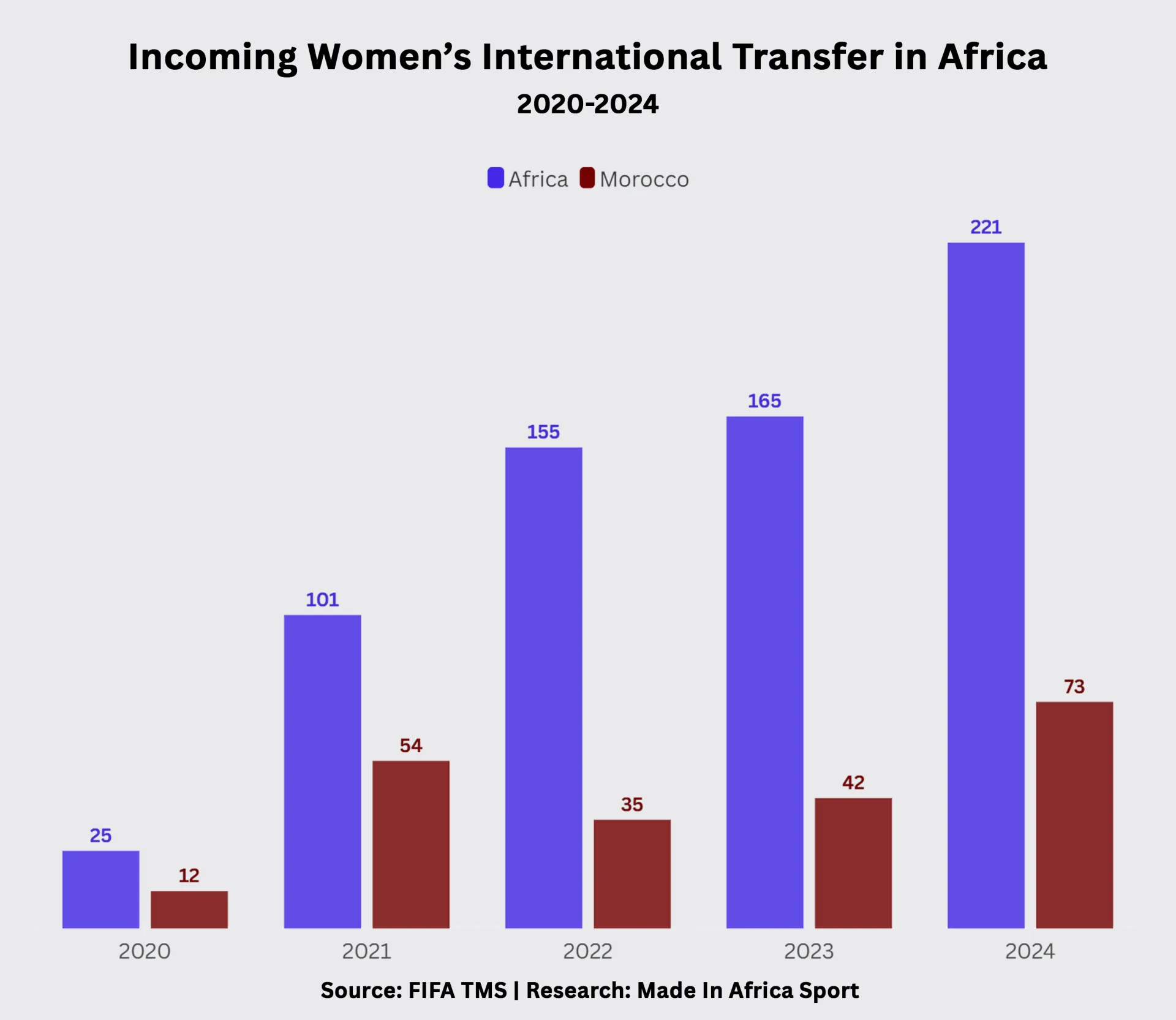
Morocco’s investment in women’s football is not random, it is a strategy that is part of a wider effort to build a competitive football structure, and they have been actively recruiting players from different parts of the world to improve the quality of their domestic league.
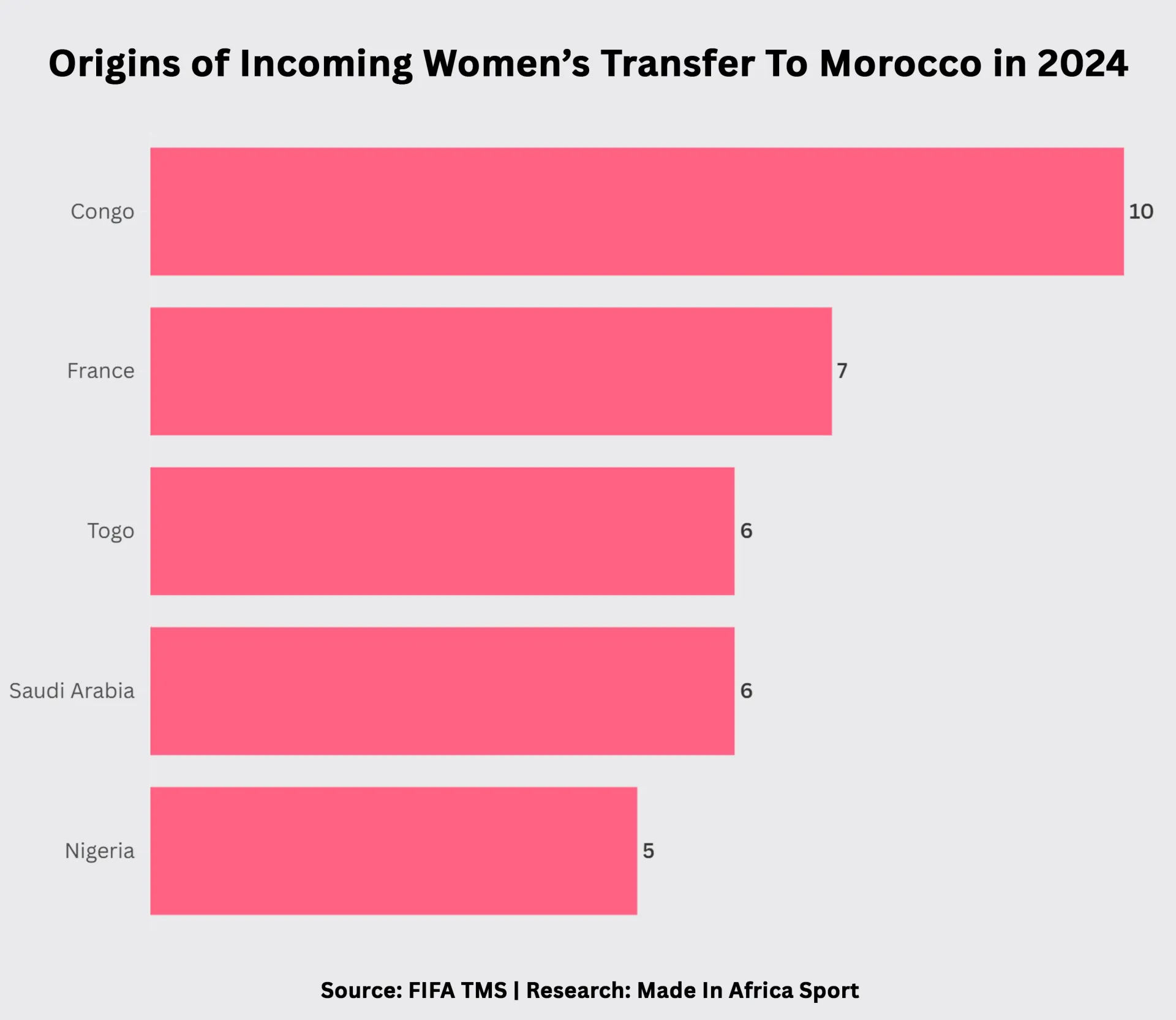
In 2024, they signed players from at least five different countries, with Congo leading the way as the top source of talent. Ten Congolese players moved to Morocco, followed by seven from France, six each from Togo and Saudi Arabia, and five from Nigeria.
This commitment to growth has set Morocco apart, but across the continent, women’s football transfers still struggle to gain financial recognition. The question now is whether African women’s international transfers are closing the gap with men’s football.
Are African women’s international transfers catching up with men’s?
African footballers have increasingly moved across international borders in recent years as a result of the sport’s expanding global reach. But has this growth been the same for men and women? The numbers suggest that while progress in women’s football has been rapid, it remains uneven.
A closer look at the data from 2020 to 2024 reveals how outgoing international transfers have evolved for African men and women.
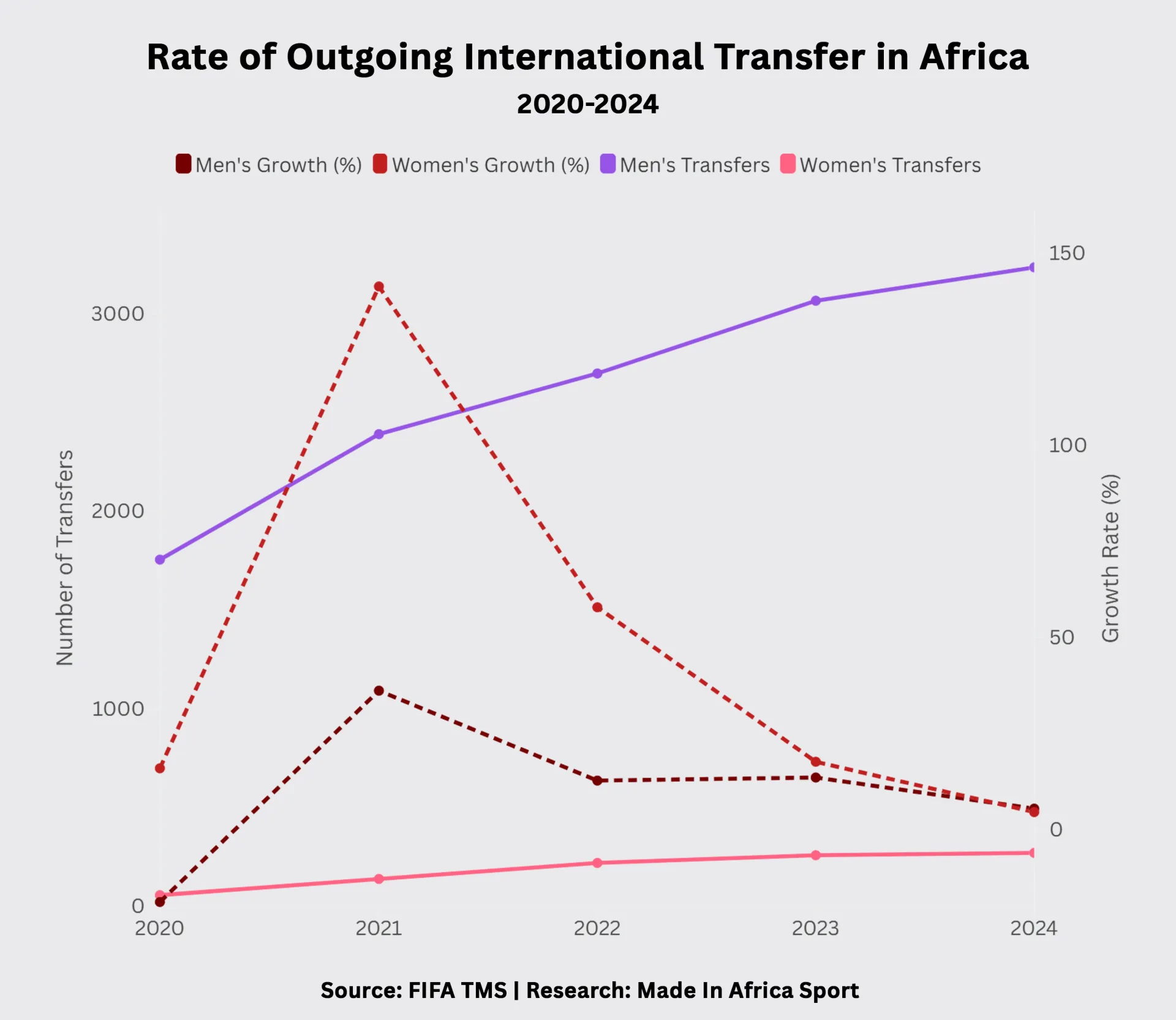
At first glance, the figures for women’s transfers paint a picture of a rapid rise. The number of African women securing international moves jumped by an extraordinary 141.4% in 2021, while men’s transfers increased by 36.2% after suffering a decline of 18.8% in the previous year when COVID-19 pandemic disrupted football markets worldwide.
In this period, women’s transfers, although smaller in scale, were one of the few areas that still recorded growth, and it continued in subsequent years, growing by 57.9% in 2022, still exceeding the 12.8% rate of increase recorded for men.
These numbers suggest more growth for African women moving abroad. However, a closer examination of absolute figures reveals a persistent gap. Even when women’s percentage growth was higher, the actual number of transfers remained far lower than men’s.
In 2021, women’s transfers increased by 82, while men’s transfers grew by 635. By 2022, women recorded 81 more transfers compared to 307 for men. The trend suggests that while women’s football is expanding at a faster rate in percentage terms, the overall volume of transfers remains heavily skewed in favour of men.
Another shift in the data presents a challenge: Women’s transfer growth is slowing down. After an impressive 141.4% rise in 2021 and a 57.9% increase in 2022, the growth rate fell to 17.7% in 2023 and just 4.6% in 2024. Meanwhile, men’s transfers have continued to rise steadily, recording 13.6% growth in 2023 and 5.5% in 2024.
The challenge now is ensuring that African women’s football does not plateau. While the numbers show progress, the decline in growth rate suggests that obstacles stemming from limited scouting, lower investment, and fewer professional opportunities may be slowing down further expansion, and without a long-term strategy, this growth could fade, and the transfer landscape may remain dominated by men’s football.
While African footballers have increasingly moved abroad, clubs within the continent have also sought international talent to strengthen their squads. As with outgoing transfers, the numbers for incoming players show growth for both men and women, though on different scales.
The figures show that while the total number of men’s transfers remains far greater, the percentage growth for women’s transfers has been striking.
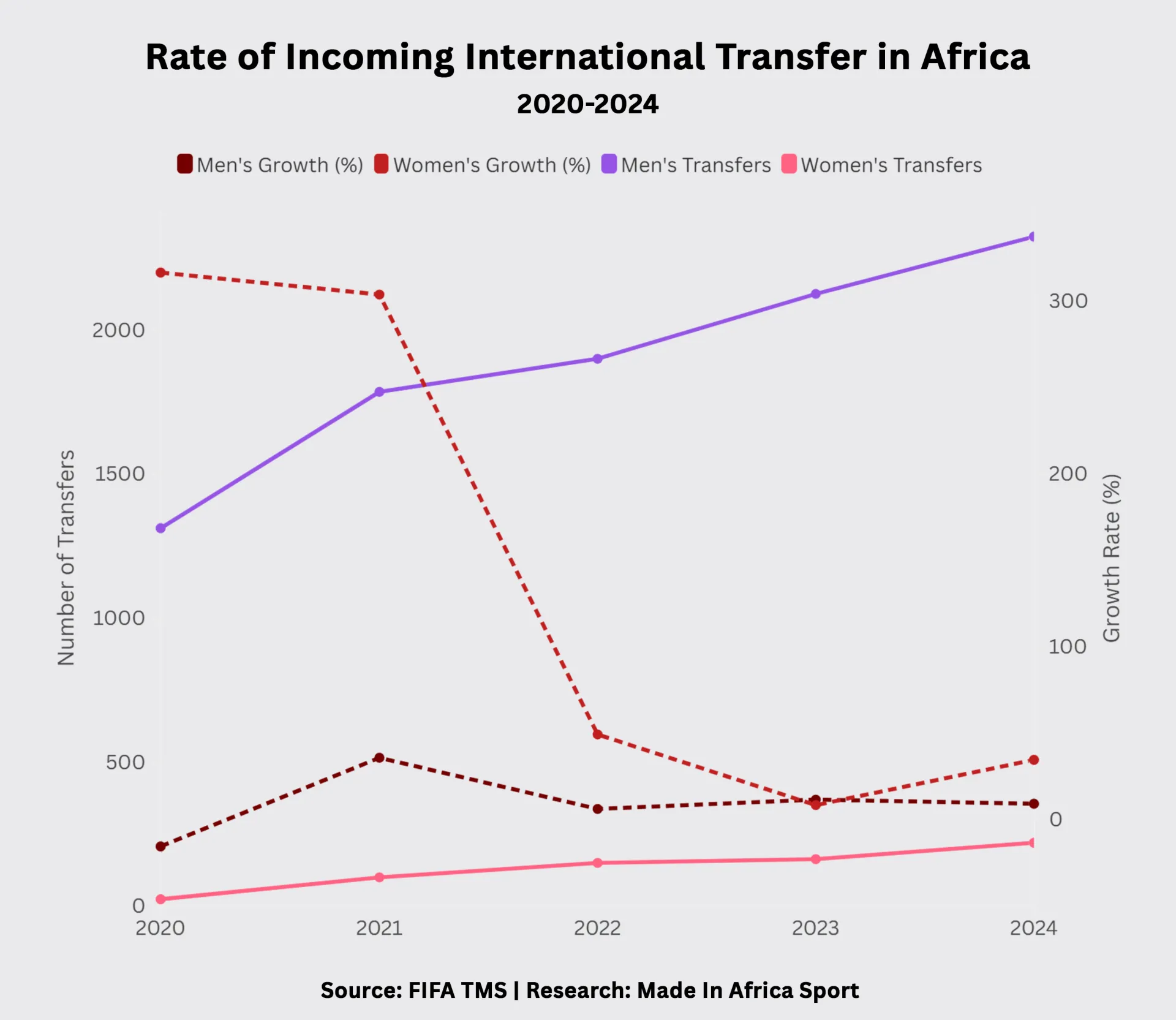
In 2020, as the football world dealt with the effects of COVID-19, men’s transfers dropped by 15.3%, yet women’s transfers saw an unexpected surge. The number of incoming female players rose by 316.7%, jumping from just six players in 2019 to 25 in 2020.
This rapid growth continued in 2021 when women’s transfers climbed by 304% compared to a 36% increase for men. The rise could be linked to the introduction of the CAF Women’s Champions League, which saw teams from 33 countries jostle for honours, with clubs increasingly looking abroad to strengthen their squads.
However, the momentum did not last. By 2022, the growth rate for women’s transfers slowed to 49.5%. In 2023, it dropped further to 8.6%, suggesting that the initial expansion had started to level out. Meanwhile, men’s transfers continued to rise at a steady pace, with double-digit growth recorded in most years.
A small resurgence in women’s transfers appeared in 2024, as the number of international signings grew by 34.8%. While this was the highest increase since 2022, the pattern remains inconsistent. The fluctuations suggest that opportunities for women to move into Africa are increasing, but not in a way that guarantees long-term stability, just as moving out internationally too.
For men’s football, the pattern has been more predictable. Even with lower percentage growth, the number of international arrivals has increased steadily. The 2024 figures show 2,325 men’s transfers compared to 221 for women, underlining the gap that remains between the two.
Transfer fees: A wide gap that shows no signs of closing
The growth in international transfers for African clubs has been evident over the past five years, but one aspect has remained unchanged: the financial gap between the two. While the number of women moving abroad or joining clubs has increased, the money involved in these deals tells a different story.
Despite rising transfer activity, women’s football in Africa continues to operate in a market where financial transactions are minimal and player valuations remain low. While men’s transfers involve six-figure deals, women’s transfers often struggle to break into the thousands. The gap in transfer fees is not just large, it is a stark reminder of how little financial value is placed on women’s football in the continent’s transfer economy.
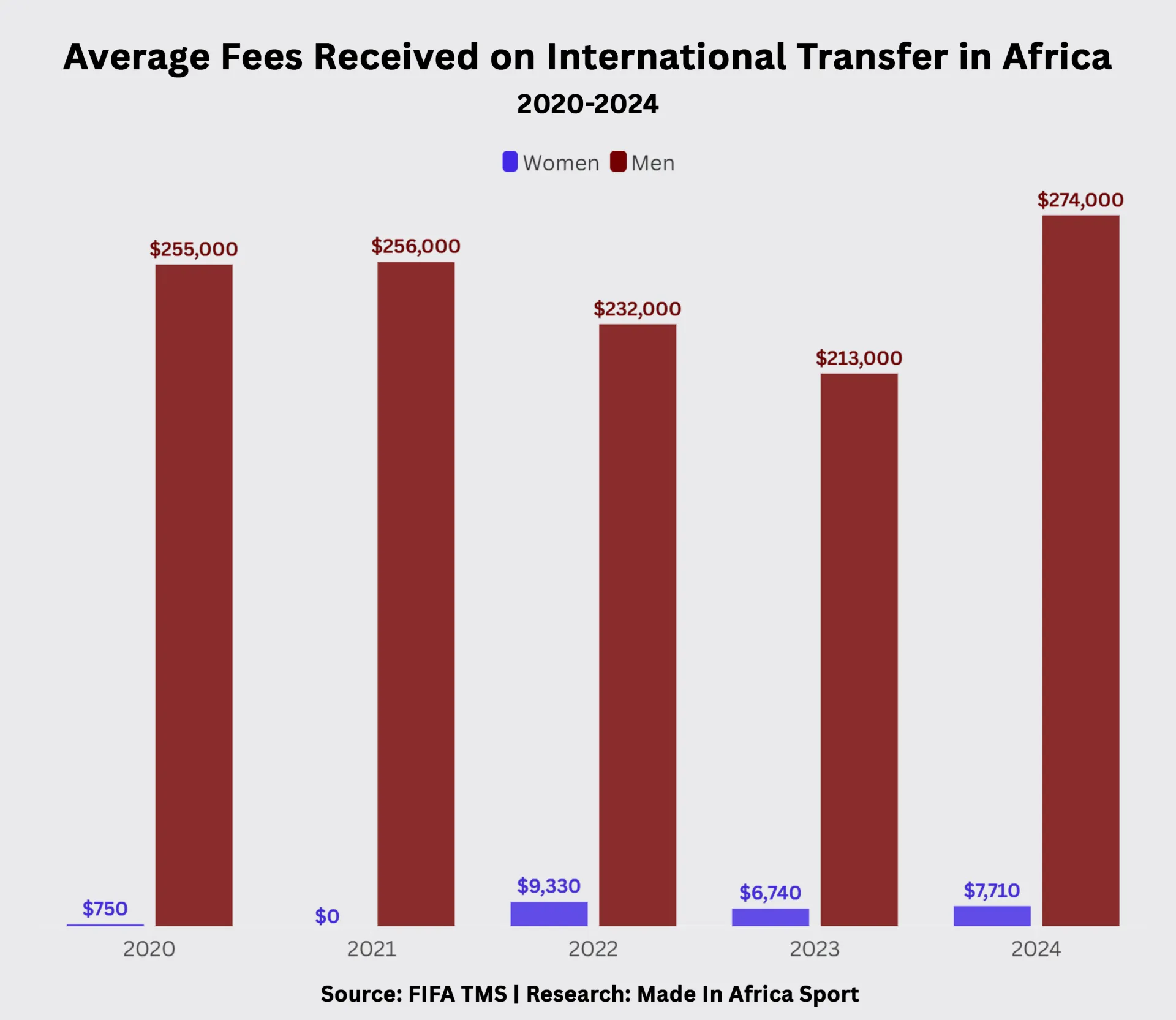
The average transfer fee received for men’s players in Africa had consistently been in the hundreds of thousands, peaking at $274,000 in 2024. For women, the highest recorded average over the past five years was just $9,330 in 2022. In some years, clubs did not receive any transfer fees for women players’ sales, showing how little value is placed on their movement in the market.
The disparity is even more pronounced when looking at the money clubs are willing to pay for players. In 2020 and 2021, no club in Africa paid a transfer fee for a women’s player. Meanwhile, men’s transfers in those same years commanded fees of $237,000 and $155,000, respectively.
Even when clubs did start paying for women’s players, the numbers were incredibly low. The highest average transfer fee paid for a women’s player over the last five years was just $1,500 in 2023, while for men, it was $260,000 in 2024.
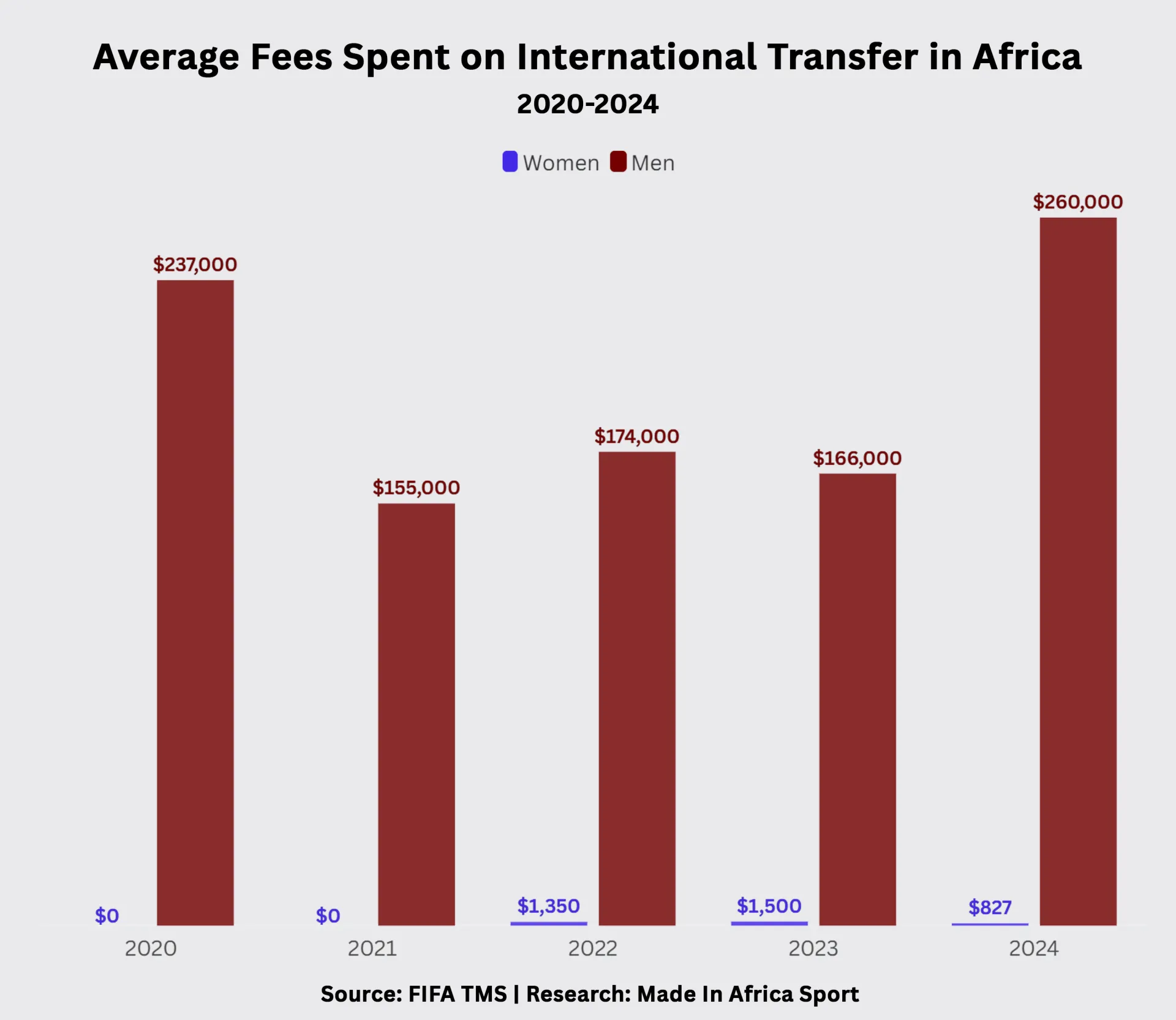
The gap in earnings reflects the lack of investment in the women’s game. While men’s football has built a strong market where clubs are willing to spend and earn millions, women’s football is still struggling to establish even a basic transfer economy in Africa.
The data makes the difference in how players are valued clear. For African men’s footballers, clubs see transfers as a business opportunity, buying and selling players at high fees. For women, however, transfers are often done with little or no financial exchange, meaning clubs do not view them as financial assets in the same way, instead, they see them as an afterthought.
But this disparity is not limited to African leagues. It extends to the international transfer market, where the story is both familiar and evolving.
The international game changers
A few years ago, it was rare to see an African player move for over $50 million. Today, the biggest clubs in the world are paying much more, signalling the rising reputation of players from the continent. The numbers have kept rising, and so has the reputation of African players who are delivering top performances in the most competitive leagues.
Côte d’Ivoire’s Nicolas Pépé holds the record as the most expensive African footballer when he moved from LOSC Lille in France to Arsenal FC in England for $88.9 million (€80.00m) in 2019. His move was expected to change Arsenal’s attacking play, and it showed how French clubs were becoming a stepping stone for African players to bigger European leagues.
Just a year later, Nigeria’s Victor Osimhen almost broke that record when he moved from the same French club to SSC Napoli in Italy for $91.2 million (€77.50m). While Osimhen remains the most expensive African footballer in dollar terms, the record in real-time market value belongs to Pépé.
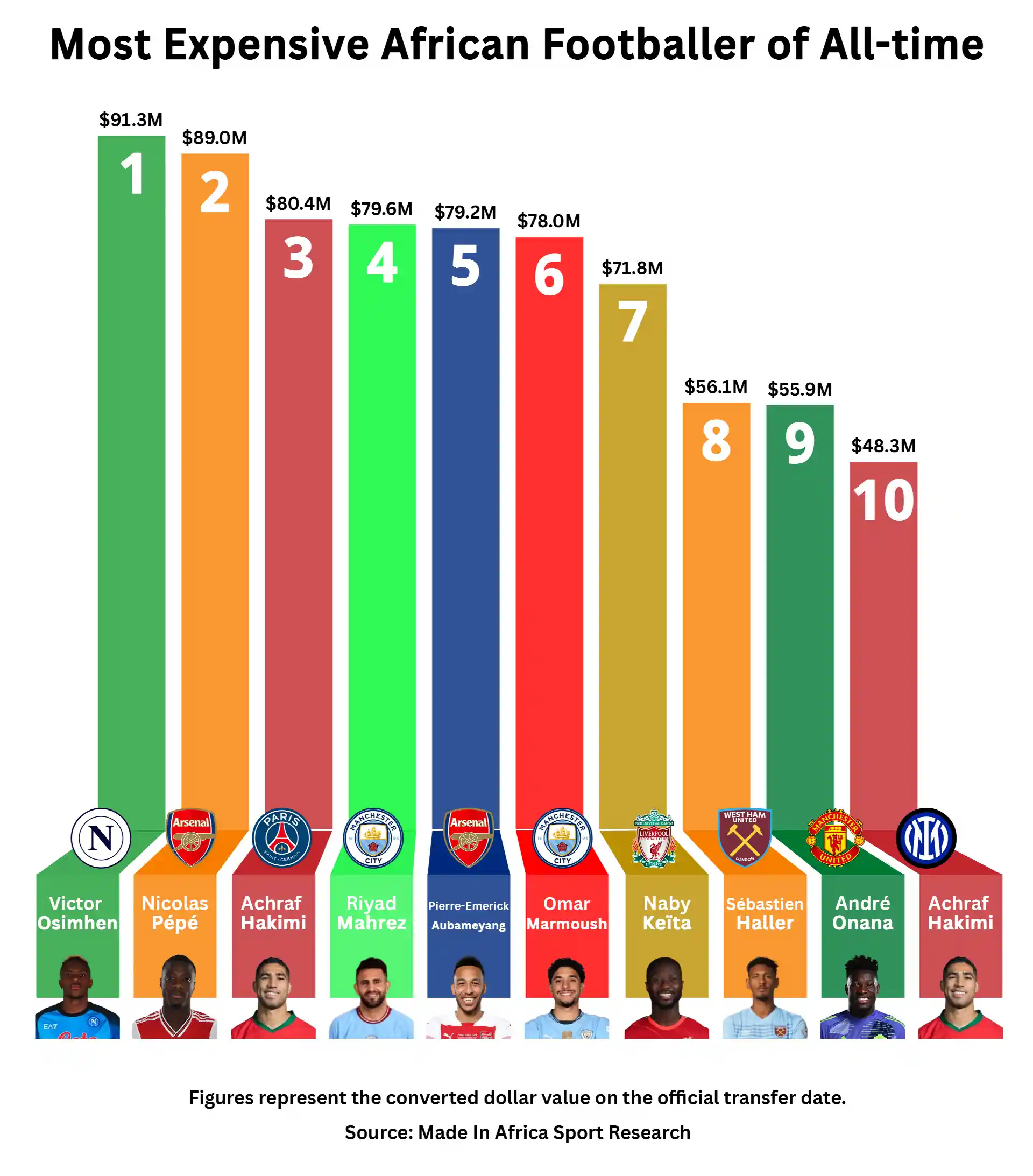
Beyond these two, Moroccan full-back Achraf Hakimi has also commanded significant fees, moving from Inter Milan to Paris Saint-Germain in 2021 for $80.3 million after a successful spell in Serie A. Before that, he had moved from Real Madrid to Inter Milan for $48.3 million in 2020.
Algeria’s Riyad Mahrez joined Manchester City from Leicester City in 2018 for $79.5 million, following his role in Leicester’s Premier League-winning season two years earlier. Pierre-Emerick Aubameyang also made a high-profile switch in 2018, moving from Borussia Dortmund to Arsenal for $79.1 million.
Egypt’s Omar Marmoush became the latest African to join the ranks of big-money transfers, completing a $78 million move from Eintracht Frankfurt to Manchester City in January 2025.
Guinea‘s Naby Keïta secured a $71.8 million transfer from RB Leipzig to Liverpool in 2017, while Sébastien Haller’s $56.1 million switch from Eintracht Frankfurt to West Ham in 2019 set a new benchmark for Ivorian players.
Cameroon’s André Onana became the most expensive African goalkeeper when he joined Manchester United from Ajax in 2023 for $55.8 million.
Egypt’s Mohamed Salah, one of Africa’s greatest football exports, moved from AS Roma to Liverpool for $46.8 million in 2017. His transfer manifested the beginning of a dominant period at Anfield, where he became the club’s third all-time top scorer.
Ghana’s Mohammed Kudus also made a big-money move in 2023, joining West Ham from Ajax for $46.4 million. His energetic playing style, dribbling, and goal-scoring ability made him one of the most exciting footballers in the Premier League.
However, international transfers tell a different story for women’s football. While the gap remains, the landscape is changing. Women’s football is now seeing some of the highest transfer fees in its history, and African players are playing a major part in that transformation.
In 2024, Zambian forward Racheal Kundananji made headlines when she became the most expensive female footballer in the world, moving from Madrid CFF to Bay FC in the United States for $862,000. That same year, another Zambian star, Barbra Banda, joined Orlando Pride from Shanghai Shengli for $740,000.
These moves show how women’s football is becoming more lucrative. A few years ago, it was almost unheard of for African women footballers to command six-figure transfer fees. Now, clubs are willing to record-breaking amounts to bring them in.
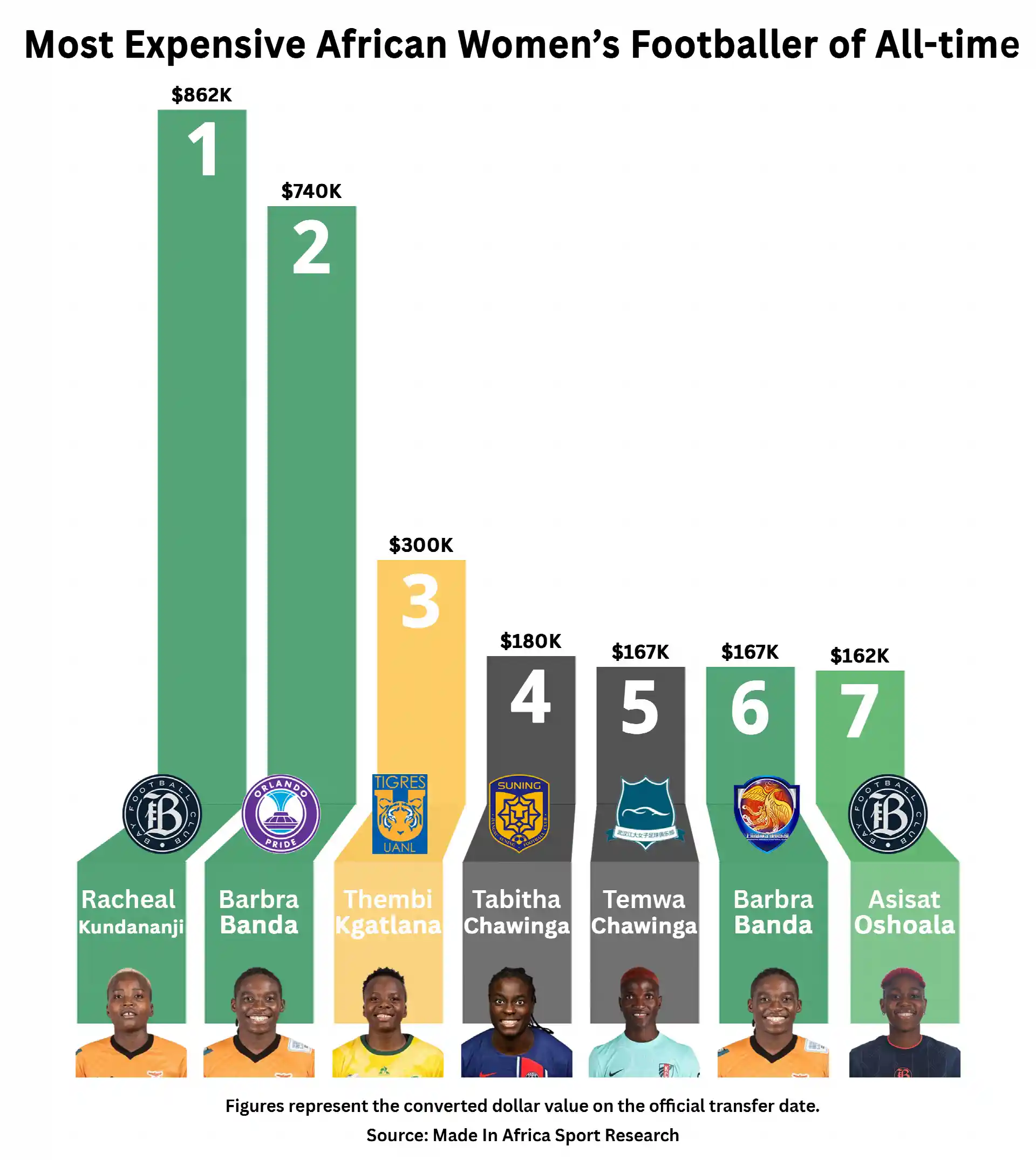
In 2023, South Africa’s Thembi Kgatlana made a $300,000 move from Racing Louisville to Tigres in Mexico. Malawian forward Tabitha Chawinga joined the ranks in 2018 with a then-continental record $180,000 switch from Kvarnsvedens in Sweden to Jiangsu in the Chinese Women’s Super League.
Her younger sister, Temwa Chawinga, followed two years later with a high-profile transfer from the same Swedish club to Wuhan Jiangda for a fee in the region of $167,000. In that same window, Barbra Banda also made a move worth a similar amount from EDF Logroño to Shanghai Shengli.
After a successful spell at Barcelona, where she became the first African to win the UEFA Champions League three times, won 14 trophies including two trebles and a quadruple, and finished as the club’s fourth all-time top scorer, record six-time African Women’s Footballer of the Year Asisat Oshoala joined the growing list of high-value African transfers with her $162,000 move to Bay FC in January 2024.
While men’s football has long dominated the market, the increasing value placed on African women players suggests a future where the financial disparity may not be as vast since the journey from the continent to the world’s biggest leagues is becoming more common, and with each transfer window, more players are making moves that would have been unthinkable just a decade ago. The football economy is changing, and African footballers are right at the centre of it.
Footballers from Africa have always been in demand across the world. From Europe to Asia and the Americas, players from the continent have left home in search of bigger opportunities, stronger competition, and better wages.
For most of them, the dream is clear: to play at the highest level, in the biggest leagues, and under the brightest lights. But for every player who makes it to Europe’s elite clubs, thousands more leave the continent in search of opportunities, navigating a system where talent alone is never enough.
Over the last five years, this movement has only intensified. Some are well-established professionals, transferring for millions of dollars, while the majority are amateurs hoping to break into the professional scene in obscure leagues rather than wait for opportunities at home. Then there are the women footballers, a growing but still underrepresented group whose international moves signal progress and the long road ahead for gender equity in football.
The data behind this migration is sourced from FIFA’s Transfer Matching System (TMS), extracted through the Global Transfer Report on 28 February 2025. It includes all international transfers of football players completed between 1 January 2020 and 31 December 2024.
At the forefront of this talent exodus is Nigeria, the undisputed leader in football exports. With 3,915 outgoing transfers since 2020, the country has supplied more footballers to foreign leagues than any other African nation. Among them, 1,992 are professional male players, a number that places Nigeria just behind Belgium in the global rankings of football exporters.
But it is not only professionals who are leaving.
More than 1,700 amateur players have also made international moves, proving that the Nigerian football dream is pursued at all levels.
FIFA defines an amateur footballer as “a player who has never signed a professional contract and does not receive any remuneration beyond the reimbursement of expenses incurred during football-related activities.”
These players, unlike professionals, are not bound by club contracts and often rely on personal networks, trials, and lower-division leagues to establish their careers abroad. Their migration spotlights the risks faced by African footballers seeking opportunities beyond their home countries.
Nigeria is also leading the way in women’s football exports, with 160 female players moving to foreign leagues directly. This is more than any other African country, proving that Nigeria is the country where women’s footballer seeks greener pastures more than elsewhere on the continent.
Ghana follows closely, exporting 2,064 players since 2020. The country has long been known for producing highly technical and disciplined footballers, with scores of them finding success in leagues across Europe and beyond. Of these transfers, 1,190 were male professional players, while 769 amateur footballers left the country in search of better opportunities.
Women’s footballers are also leaving Ghana rapidly, with a continent-high 38 players transferring out internationally in 2024 for a total of 105 players over the last five years. This puts Ghana just behind Nigeria and ahead of all other 42 African nations to have sold at least a single player in that period.
Beyond West Africa, Morocco, Tunisia, and Egypt have also sent large numbers of players abroad, showing that North Africa is also a region for football exports.
Morocco has seen 1,588 players leave the country for foreign leagues, with 34 being professional women and 543 professional men, while the remaining 1,011 representing 64% of the country’s total export over the last half-decade are amateurs.
A further microscopic analysis depicts that while their numbers are not as high as those of Nigeria, Moroccan amateur departures are largely due to limited local opportunities or because of the strong scouting networks since they move to their fellow Arab leagues or developed southwestern Europe, unlike Nigerians with Czechia, Albania, Poland and Benin being their major destinations.
Tunisia and Egypt follow closely behind, with 1,475 and 1,343 outgoing transfers, respectively. Just like Morocco, their women’s football exports remain low, with Tunisia producing only 23 international transfers and Egypt 22.
Cameroon and Côte d’Ivoire have continued their tradition of producing top footballing talent, each exporting over 1,200 players in the last five years. Côte d’Ivoire saw 749 professional male players leave the country, a figure that is higher than Cameroon’s 624. However, Cameroon has exported more female players, with 50 Cameroonian women securing transfers abroad compared to 47 from Côte d’Ivoire. Both countries also have a strong amateur football culture, with hundreds of young players choosing to take their chances outside Africa.
Algeria, Senegal, and South Africa complete the list of the top ten African nations producing the most exported players. Algeria has recorded 1,085 transfers, a number that is lower than that of its North African rivals but still places it among the biggest contributors to global football talent. Senegal, a country with a much smaller population compared to some of the other top nations, has exported 1,036 players, proving that football remains one of its strongest assets. Many Senegalese players have found success in French football, a trend that is likely to continue due to the historical ties between the two countries.
South Africa is in a unique position when it comes to football exports. The country has the best economy and one of the strongest domestic leagues on the continent, meaning fewer players seek moves abroad compared to other African nations. However, with 967 outgoing transfers over the last five years, South Africa remains an important producer of football talent. The country has also seen 28 female players make international moves directly over the last five years, a number that is lower when taking into consideration how big women’s football is in the country and how dominant their teams have been at both clubs and international levels.
Where do African players go? A look at the most common destinations
The data over the last five years also shows where African footballers are most likely to go, revealing patterns of the strongest football ties between Africa and the rest of the world.
Europe remains the most popular destination, with 10,160 players moving to clubs across UEFA-affiliated countries. This figure includes 6,220 amateur players, showing that many young African footballers are willing to take the chance of moving to European lower divisions and academies even before securing professional contracts.
Among professional players, 3,666 male footballers made the move, while 274 female players also transferred to European clubs. The numbers confirm Europe as the biggest importer of African talent, a trend that has existed for decades. With top leagues such as the English Premier League, La Liga, and Ligue 1 heavily scouting Africa, it is no surprise that a large number of players continue to move to Europe.
Within the African continent itself, there has been a high level of internal movement. A total of 9,870 local African players have transferred to other clubs within CAF-affiliated countries. This is the second-highest total after Europe and shows that many African players still prefer to stay within the continent rather than move far away.
The majority of these transfers are professional moves, with 6,909 male players switching clubs within Africa. This suggests that despite the growing trend of international transfers, African domestic leagues still have strong recruitment networks that allow talent to move between different countries. The amateur game is also thriving within the continent, with 2,444 amateur players transferring to clubs in other African nations.
Women’s football has also been active in this internal market, with 517 female footballers moving between African leagues. While this number is lower than men’s transfers, it shows that women’s football in Africa is developing and that players are finding opportunities within the continent.
Asian football has also been attracting African players, with 4,271 transfers to AFC-affiliated clubs. A total of 2,333 professional male players have moved to Asia, a sign of the growing relationship between African footballers and leagues in countries such as Saudi Arabia, Qatar, the United Arab Emirates, and China.
Amateur footballers have also found opportunities in Asia, with 1,791 moving to clubs across the continent. Women’s transfers to Asia, however, remain low, with only 147 female players making the move. Despite this, the numbers indicate that Africa-to-Asia transfers are becoming more common, especially as wealthy Asian leagues continue to invest in foreign talent.
North and Central American leagues under CONCACAF have not been as popular as European or Asian leagues, but they have still attracted 566 African players over the last five years. Most of these transfers have been amateur moves, with 458 players making their way to clubs in North and Central America or the Caribbean. Professional men’s transfers have been much lower, with only 107 male players moving to CONCACAF-affiliated leagues. Women’s football in the region has received very few African players, with just one transfer recorded over the five years.
South American football has traditionally not been a major destination for African players, and the data confirms this. Only 203 African footballers have moved to CONMEBOL-affiliated clubs in the last five years. This includes 144 professional male players and 57 amateurs. Women’s football transfers to South America have been almost non-existent, with just two female African footballers moving to clubs in the region.
The Oceania region has seen the least number of transfers, with only 126 African footballers moving from the continent to OFC-affiliated clubs. All of these have been amateur transfers, with the entire 126 players moving to teams in countries like New Zealand and the Pacific Islands. There have been no recorded professional men’s or women’s transfers to Oceania in the last five years, making it the least common destination for African footballers. Vice versa, there was no recorded professional player transfer from Oceania to Africa either, showing that there are zero historical ties between Africa and Oceania.
The African nations bringing in the most foreign footballers
While it is good that African players are being recognised and recruited by foreign leagues, there is also the issue of how to strengthen African domestic competitions so that fewer players feel the need to leave. Even though the real question is whether they can retain their top talents rather than just serving as a stepping stone to Europe and Asia, the level of internal transfers within Africa itself and also small-scale importations from abroad suggests that the continent’s leagues are growing.
Football is a sport of movement, not just on the pitch, but also across borders. While much is said about African players leaving the continent for foreign leagues, there is also a growing trend of players moving into Africa.
Over the last five years, some African countries have increased their intake of foreign players, attracting talent from around the world. Whether for financial reasons, league development, or strategic recruitment, these countries are now becoming major importers of footballers, shifting the narrative of African football as purely an exporter of talent.
Libya took the top spot as the biggest importer of footballers in Africa, with a total of 1,283 international transfers recorded. While the country has faced challenges on all fronts in recent years, football remains an important part of its identity. The majority of these transfers have been amateur players, with 695 moving into Libya, while 588 professional male footballers have also joined Libyan clubs. Women’s football, however, has yet to see any international transfers, palpably due to the absence of a women’s league in the country.
Morocco has also been a major destination for foreign players, bringing in 1,000 international transfers. Unlike Libya, Morocco’s recruitment has been more balanced, with a strong presence in women’s football as well. Out of the total imports, 673 were professional male players, while 216 female footballers also joined Moroccan clubs. This makes Morocco the topmost African country actively attracting foreign women’s talent, showing their commitment to the growth of women’s football. Amateur transfers have been fewer, with only 111 players moving in at that level.
Benin is another country that has seen a surge in foreign player recruitment, bringing in 922 transfers, of which 299 are amateurs. The country has mostly targeted professional male players, with 657 moving to Beninese clubs. Women’s football, which has not seen much growth, had 36 female players arriving from abroad.
Interestingly, Benin has been raiding their bordering neighbour, Nigeria, to poach players. Of all the 242 international transfers the country had in 2024, 120 were Nigerians, representing 50% of their entire imports.
Fourth in most international signings is Tunisia, a country that has long been one of Africa’s most competitive football nations, and it continues to attract foreign talent, predominantly in men’s professional football. A total of 735 international players arrived in the country, with 705 of them being professional male players.
This heavy focus on the men’s game shows that Tunisia remains a key market for players looking to break into Africa’s top leagues. Like Libya, Tunisia has seen no recorded international transfers in women’s football despite the presence of the Tunisian Women’s Championship that has been running for 20 years, indicating that recruitment strategies have been more focused on maintaining the strength of the men’s league only.
Ghana, which has always been known for exporting talent, is also bringing in foreign players, with 685 international transfers recorded. Most of these have been professional male players, with 549 joining Ghanaian clubs. Women’s football is also seeing some movement, with 30 female players arriving in Ghana over the last five years. Amateur transfers have been more limited, with 106 players joining at that level. The numbers suggest that while Ghanaian football remains largely focused on developing homegrown talent, there is also a growing interest in foreign recruitment to boost domestic competition, at least in men’s football.
Côte d’Ivoire has been another active recruiter of foreign players, with 558 international transfers recorded. The country has seen a balanced mix of amateur and professional imports, with 208 amateur transfers and 344 professional male transfers. Women’s football, however, has had fewer international arrivals, with just six female players recorded.
Egypt, one of Africa’s footballing giants, has also been welcoming foreign players, with 551 transfers recorded. A total of 480 professional male players have joined Egyptian clubs, while 63 female players have also been recruited. However, amateur transfers have been almost nonexistent, with only eight recorded over the last five years, a trend that suggests Egypt’s clubs are mainly targeting experienced players rather than bringing in young talents to develop over time.
Tanzania has emerged as a rising force in African football, attracting 514 international transfers. The country’s recruitment strategy has been more balanced, with 371 professional male players joining Tanzanian clubs. Women’s football has also been an area of focus, with 126 international female transfers recorded, making Tanzania one of the top African nations in this category. However, amateur transfers have been low, with only 17 recorded.
Rwanda has also been increasing its intake of foreign footballers, with 480 international transfers. The majority have been professional male players, with 404 joining Rwandan clubs. Amateur transfers have been relatively low at 65, while women’s football has seen only 11 international arrivals.
South Africa completes the top 10 having brought in 459 foreign players over the last five years. Most of these have been professional male players, with 295 transfers recorded. Amateur football has also been active, with 163 players moving to South African clubs. However, they have one recorded foreign incoming women’s transfer, meaning the country is nearly absent from the international women’s transfers scene with a total of 29 net transfers in five years, placing them 13th on the list of countries with the most involvement in women’s transfer on the continent despite their strong domestic league structure.
Investment in women’s football: Are their transfers becoming more financially competitive in Africa?
Women’s football transfers have seen unprecedented growth worldwide, but in Africa, the financial competitiveness of the market remains far behind. While global spending on female transfers reached record levels in 2024, African nations barely made a dent in the numbers.
Clubs worldwide spent 15.6 million dollars on women’s international transfers in 2024, more than double the 6.1 million dollars recorded in 2023.
The number of clubs involved in deals with transfer fees also reached an all-time high, with 109 clubs spending money and 124 clubs receiving fees. Leading the way were clubs from England, Spain, and the United States, where player sales brought in millions of dollars. No African nation came close to those figures.
Ghanian clubs led the continent in outgoing transfers, with 38 players moving abroad in 2024, placing the country 20th worldwide. Nigeria followed closely in 21st place with 37 players. Yet, these transfers barely translated into substantial financial returns as the entire continent received just 61,700 dollars in total transfer fees for female players.
From this, Ghana accounted for 16,200 dollars, while Nigeria earned 6,005 dollars, and the remaining 34 African nations involved in transfers shared 39,495 dollars from the 197 players they exported.
While this marked a 23.5% increase from 2023, it was still lower than in 2022, when 131,000 dollars was earned from player sales.
The inconsistency in revenue from these transfers suggests that African clubs are not yet in a position to negotiate higher fees for their players, despite increased participation in the global market, and the pattern is even more concerning when looking at the money spent on signing foreign players.
In 2024, 16 African countries signed female players from abroad, yet the total amount spent was just 3,310 dollars. This was almost three times lower than the record 8,120 dollars spent in 2022, indicating a continued reluctance to invest in recruiting talent.
These fluctuations in spending and earnings reflect an unstable transfer market for African women’s football. The sharp rise in transfer revenue in 2022, followed by a steep decline in 2023, suggests that African clubs are not consistently benefiting from the international market. Likewise, the decrease in spending on foreign players shows that investment in squad improvement is not a priority for most African teams.
However, one country has been pushing against this trend. While the rest of Africa struggles with low investment in women’s transfers, Morocco has been making moves to strengthen its league.
The North African country accounted for 33% of all international women’s transfers into Africa in 2024, signing 73 players. It was a record-breaking figure for Morocco and a clear statement of intent.
Their commitment to women’s football has been evident over the last five years. In 2020, Morocco brought in just 12 foreign players. By 2021, that number had skyrocketed to 54. There was a dip to 35 in 2022 before the numbers began to rise again, reaching 42 in 2023 and an all-time high of 73 in 2024.
Morocco’s investment in women’s football is not random, it is a strategy that is part of a wider effort to build a competitive football structure, and they have been actively recruiting players from different parts of the world to improve the quality of their domestic league.
In 2024, they signed players from at least five different countries, with Congo leading the way as the top source of talent. Ten Congolese players moved to Morocco, followed by seven from France, six each from Togo and Saudi Arabia, and five from Nigeria.
This commitment to growth has set Morocco apart, but across the continent, women’s football transfers still struggle to gain financial recognition. The question now is whether African women’s international transfers are closing the gap with men’s football.
Are African women’s international transfers catching up with men’s?
African footballers have increasingly moved across international borders in recent years as a result of the sport’s expanding global reach. But has this growth been the same for men and women? The numbers suggest that while progress in women’s football has been rapid, it remains uneven.
A closer look at the data from 2020 to 2024 reveals how outgoing international transfers have evolved for African men and women.
At first glance, the figures for women’s transfers paint a picture of a rapid rise. The number of African women securing international moves jumped by an extraordinary 141.4% in 2021, while men’s transfers increased by 36.2% after suffering a decline of 18.8% in the previous year when COVID-19 pandemic disrupted football markets worldwide.
In this period, women’s transfers, although smaller in scale, were one of the few areas that still recorded growth, and it continued in subsequent years, growing by 57.9% in 2022, still exceeding the 12.8% rate of increase recorded for men.
These numbers suggest more growth for African women moving abroad. However, a closer examination of absolute figures reveals a persistent gap. Even when women’s percentage growth was higher, the actual number of transfers remained far lower than men’s.
In 2021, women’s transfers increased by 82, while men’s transfers grew by 635. By 2022, women recorded 81 more transfers compared to 307 for men. The trend suggests that while women’s football is expanding at a faster rate in percentage terms, the overall volume of transfers remains heavily skewed in favour of men.
Another shift in the data presents a challenge: Women’s transfer growth is slowing down. After an impressive 141.4% rise in 2021 and a 57.9% increase in 2022, the growth rate fell to 17.7% in 2023 and just 4.6% in 2024. Meanwhile, men’s transfers have continued to rise steadily, recording 13.6% growth in 2023 and 5.5% in 2024.
The challenge now is ensuring that African women’s football does not plateau. While the numbers show progress, the decline in growth rate suggests that obstacles stemming from limited scouting, lower investment, and fewer professional opportunities may be slowing down further expansion, and without a long-term strategy, this growth could fade, and the transfer landscape may remain dominated by men’s football.
While African footballers have increasingly moved abroad, clubs within the continent have also sought international talent to strengthen their squads. As with outgoing transfers, the numbers for incoming players show growth for both men and women, though on different scales.
The figures show that while the total number of men’s transfers remains far greater, the percentage growth for women’s transfers has been striking.
In 2020, as the football world dealt with the effects of COVID-19, men’s transfers dropped by 15.3%, yet women’s transfers saw an unexpected surge. The number of incoming female players rose by 316.7%, jumping from just six players in 2019 to 25 in 2020.
This rapid growth continued in 2021 when women’s transfers climbed by 304% compared to a 36% increase for men. The rise could be linked to the introduction of the CAF Women’s Champions League, which saw teams from 33 countries jostle for honours, with clubs increasingly looking abroad to strengthen their squads.
However, the momentum did not last. By 2022, the growth rate for women’s transfers slowed to 49.5%. In 2023, it dropped further to 8.6%, suggesting that the initial expansion had started to level out. Meanwhile, men’s transfers continued to rise at a steady pace, with double-digit growth recorded in most years.
A small resurgence in women’s transfers appeared in 2024, as the number of international signings grew by 34.8%. While this was the highest increase since 2022, the pattern remains inconsistent. The fluctuations suggest that opportunities for women to move into Africa are increasing, but not in a way that guarantees long-term stability, just as moving out internationally too.
For men’s football, the pattern has been more predictable. Even with lower percentage growth, the number of international arrivals has increased steadily. The 2024 figures show 2,325 men’s transfers compared to 221 for women, underlining the gap that remains between the two.
Transfer fees: A wide gap that shows no signs of closing
The growth in international transfers for African clubs has been evident over the past five years, but one aspect has remained unchanged: the financial gap between the two. While the number of women moving abroad or joining clubs has increased, the money involved in these deals tells a different story.
Despite rising transfer activity, women’s football in Africa continues to operate in a market where financial transactions are minimal and player valuations remain low. While men’s transfers involve six-figure deals, women’s transfers often struggle to break into the thousands. The gap in transfer fees is not just large, it is a stark reminder of how little financial value is placed on women’s football in the continent’s transfer economy.
The average transfer fee received for men’s players in Africa had consistently been in the hundreds of thousands, peaking at $274,000 in 2024. For women, the highest recorded average over the past five years was just $9,330 in 2022. In some years, clubs did not receive any transfer fees for women players’ sales, showing how little value is placed on their movement in the market.
The disparity is even more pronounced when looking at the money clubs are willing to pay for players. In 2020 and 2021, no club in Africa paid a transfer fee for a women’s player. Meanwhile, men’s transfers in those same years commanded fees of $237,000 and $155,000, respectively.
Even when clubs did start paying for women’s players, the numbers were incredibly low. The highest average transfer fee paid for a women’s player over the last five years was just $1,500 in 2023, while for men, it was $260,000 in 2024.
The gap in earnings reflects the lack of investment in the women’s game. While men’s football has built a strong market where clubs are willing to spend and earn millions, women’s football is still struggling to establish even a basic transfer economy in Africa.
The data makes the difference in how players are valued clear. For African men’s footballers, clubs see transfers as a business opportunity, buying and selling players at high fees. For women, however, transfers are often done with little or no financial exchange, meaning clubs do not view them as financial assets in the same way, instead, they see them as an afterthought.
But this disparity is not limited to African leagues. It extends to the international transfer market, where the story is both familiar and evolving.
The international game changers
A few years ago, it was rare to see an African player move for over $50 million. Today, the biggest clubs in the world are paying much more, signalling the rising reputation of players from the continent. The numbers have kept rising, and so has the reputation of African players who are delivering top performances in the most competitive leagues.
Côte d’Ivoire’s Nicolas Pépé holds the record as the most expensive African footballer when he moved from LOSC Lille in France to Arsenal FC in England for $88.9 million (€80.00m) in 2019. His move was expected to change Arsenal’s attacking play, and it showed how French clubs were becoming a stepping stone for African players to bigger European leagues.
Just a year later, Nigeria’s Victor Osimhen almost broke that record when he moved from the same French club to SSC Napoli in Italy for $91.2 million (€77.50m). While Osimhen remains the most expensive African footballer in dollar terms, the record in real-time market value belongs to Pépé.
Beyond these two, Moroccan full-back Achraf Hakimi has also commanded significant fees, moving from Inter Milan to Paris Saint-Germain in 2021 for $80.3 million after a successful spell in Serie A. Before that, he had moved from Real Madrid to Inter Milan for $48.3 million in 2020.
Algeria’s Riyad Mahrez joined Manchester City from Leicester City in 2018 for $79.5 million, following his role in Leicester’s Premier League-winning season two years earlier. Pierre-Emerick Aubameyang also made a high-profile switch in 2018, moving from Borussia Dortmund to Arsenal for $79.1 million.
Egypt’s Omar Marmoush became the latest African to join the ranks of big-money transfers, completing a $78 million move from Eintracht Frankfurt to Manchester City in January 2025.
Guinea’s Naby Keïta secured a $71.8 million transfer from RB Leipzig to Liverpool in 2017, while Sébastien Haller’s $56.1 million switch from Eintracht Frankfurt to West Ham in 2019 set a new benchmark for Ivorian players.
Cameroon’s André Onana became the most expensive African goalkeeper when he joined Manchester United from Ajax in 2023 for $55.8 million.
Egypt’s Mohamed Salah, one of Africa’s greatest football exports, moved from AS Roma to Liverpool for $46.8 million in 2017. His transfer manifested the beginning of a dominant period at Anfield, where he became the club’s third all-time top scorer.
Ghana’s Mohammed Kudus also made a big-money move in 2023, joining West Ham from Ajax for $46.4 million. His energetic playing style, dribbling, and goal-scoring ability made him one of the most exciting footballers in the Premier League.
However, international transfers tell a different story for women’s football. While the gap remains, the landscape is changing. Women’s football is now seeing some of the highest transfer fees in its history, and African players are playing a major part in that transformation.
In 2024, Zambian forward Racheal Kundananji made headlines when she became the most expensive female footballer in the world, moving from Madrid CFF to Bay FC in the United States for $862,000. That same year, another Zambian star, Barbra Banda, joined Orlando Pride from Shanghai Shengli for $740,000.
These moves show how women’s football is becoming more lucrative. A few years ago, it was almost unheard of for African women footballers to command six-figure transfer fees. Now, clubs are willing to record-breaking amounts to bring them in.
In 2023, South Africa’s Thembi Kgatlana made a $300,000 move from Racing Louisville to Tigres in Mexico. Malawian forward Tabitha Chawinga joined the ranks in 2018 with a then-continental record $180,000 switch from Kvarnsvedens in Sweden to Jiangsu in the Chinese Women’s Super League.
Her younger sister, Temwa Chawinga, followed two years later with a high-profile transfer from the same Swedish club to Wuhan Jiangda for a fee in the region of $167,000. In that same window, Barbra Banda also made a move worth a similar amount from EDF Logroño to Shanghai Shengli.
After a successful spell at Barcelona, where she became the first African to win the UEFA Champions League three times, won 14 trophies including two trebles and a quadruple, and finished as the club’s fourth all-time top scorer, record six-time African Women’s Footballer of the Year Asisat Oshoala joined the growing list of high-value African transfers with her $162,000 move to Bay FC in January 2024.
While men’s football has long dominated the market, the increasing value placed on African women players suggests a future where the financial disparity may not be as vast since the journey from the continent to the world’s biggest leagues is becoming more common, and with each transfer window, more players are making moves that would have been unthinkable just a decade ago. The football economy is changing, and African footballers are right at the centre of it.